

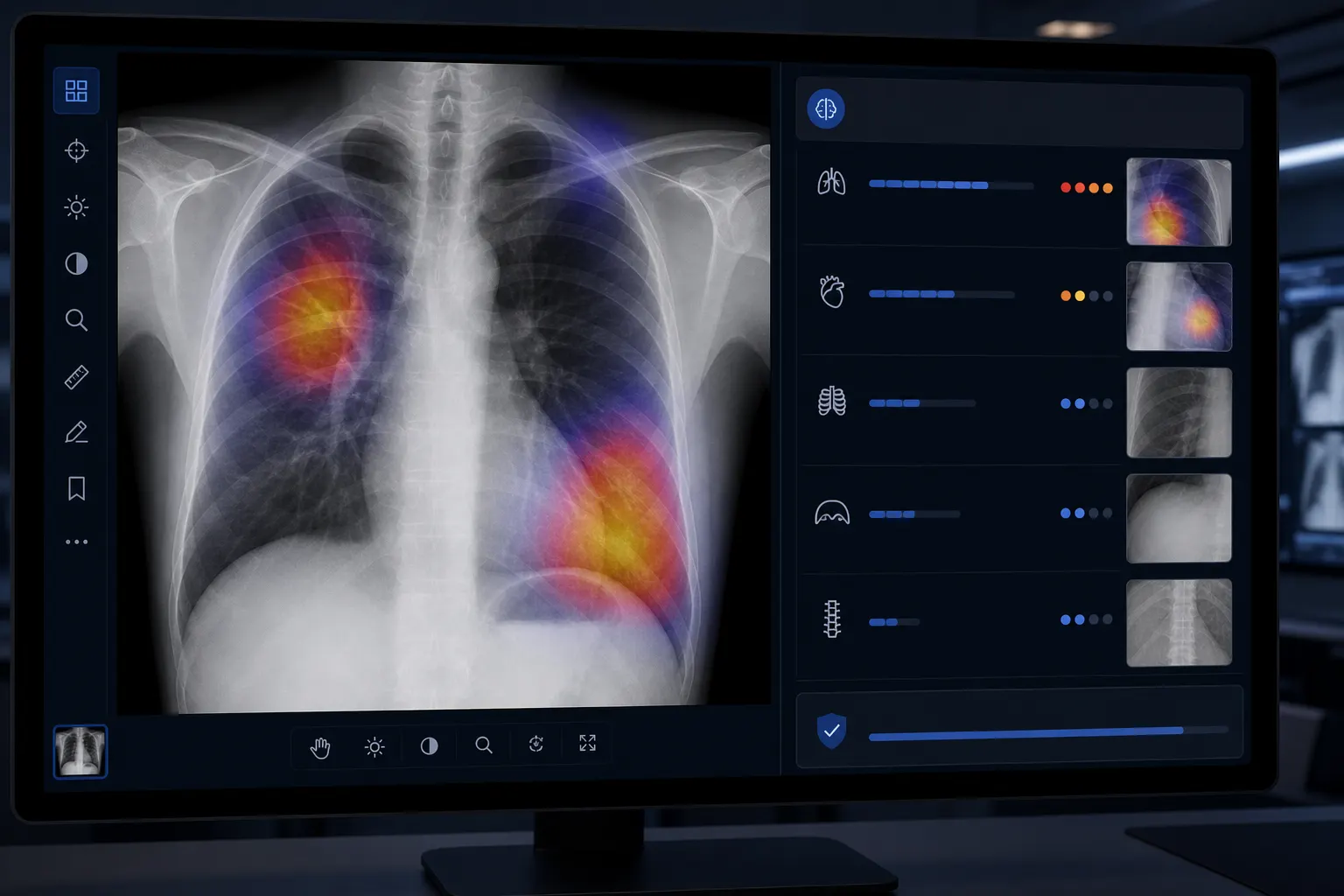
Diagnostic imaging is central to emergency medicine: chest radiography, computed tomography, and point-of-care ultrasound collectively inform the majority of high-stakes ED clinical decisions. The speed and accuracy of image interpretation directly determines time-to-treatment for conditions including pneumothorax, intracranial haemorrhage, pulmonary embolism, and aortic dissection. Computer vision algorithms—deep learning models trained on annotated medical image datasets—have achieved performance levels that match or exceed specialist radiologist accuracy for a growing number of emergency-relevant findings, creating a new paradigm for AI-assisted imaging review.
Chest Radiograph and CT Interpretation
Published benchmark studies for AI chest radiograph interpretation demonstrate competitive performance with thoracic radiologists across multiple pathology classes. The CheXNet model (Rajpurkar et al., 2017) achieved F1 scores exceeding the mean radiologist performance on pneumonia detection from the CheXpert dataset. For pneumothorax detection—a time-critical finding in the ED—AI models report sensitivities of 88–94% with specificities of 91–97%, enabling automated triage of radiograph queues to surface urgent findings before standard radiologist workflow. In the CT domain, AI algorithms for intracranial haemorrhage (ICH) detection on non-contrast CT have received FDA clearance and European CE marking, with multiple prospective validation studies demonstrating that AI-flagged ICH cases receive radiologist review a median of 9–15 minutes earlier than non-flagged cases—a clinically meaningful acceleration for neurocritical intervention decisions.
Point-of-Care Ultrasound and AI
Point-of-care ultrasound (POCUS) is increasingly embedded in emergency medicine training curricula, but interpretation quality varies significantly with operator experience. AI assistance for POCUS interpretation—providing real-time guidance on probe placement, automatic calculation of ejection fraction, and detection of pericardial effusion or free intraperitoneal fluid—has been demonstrated to improve diagnostic accuracy for less-experienced operators. The EchoNous Kosmos platform and Butterfly Network’s AI tools exemplify this category of assistive imaging AI, which is designed not to replace the clinician but to reduce the operator skill differential, democratising high-quality POCUS interpretation across experience levels.
Workflow Integration and Clinical Governance
The clinical governance framework for AI imaging tools in emergency medicine involves several non-trivial considerations. AI systems should function as notification tools within a radiologist-accountable workflow, not as autonomous reporters—a position endorsed by the Royal College of Radiologists and the European Society of Radiology. False positives from AI imaging tools impose a cost in unnecessary clinical interventions; false negatives carry the risk of missed diagnoses. The post-market surveillance requirements of the EU MDR mandate ongoing monitoring of sensitivity and specificity in the deployed clinical population, with mandatory performance reporting to the Notified Body if significant degradation is detected. Health systems deploying AI imaging tools must have defined escalation pathways for cases where AI and clinical assessment diverge, and transparent communication with patients regarding the use of AI in their diagnostic workup.