

Body Temperature as a Clinical Signal
Body temperature is among the oldest and most universally applied clinical measurements, reflecting the balance between heat production through metabolic processes and heat dissipation through the integumentary, respiratory, and cardiovascular systems. Pyrexia — the elevation of core body temperature above homeostatic set points — is a physiologically mediated response to infectious, inflammatory, and neoplastic stimuli, providing clinicians with a sensitive, readily accessible indicator that systemic pathology may be present. Despite its apparent simplicity, body temperature assessment in clinical practice is subject to substantial method-dependent variability and benefits significantly from intelligent interpretation frameworks that contextualize individual measurements.
Infrared Thermometry and Non-Contact Assessment
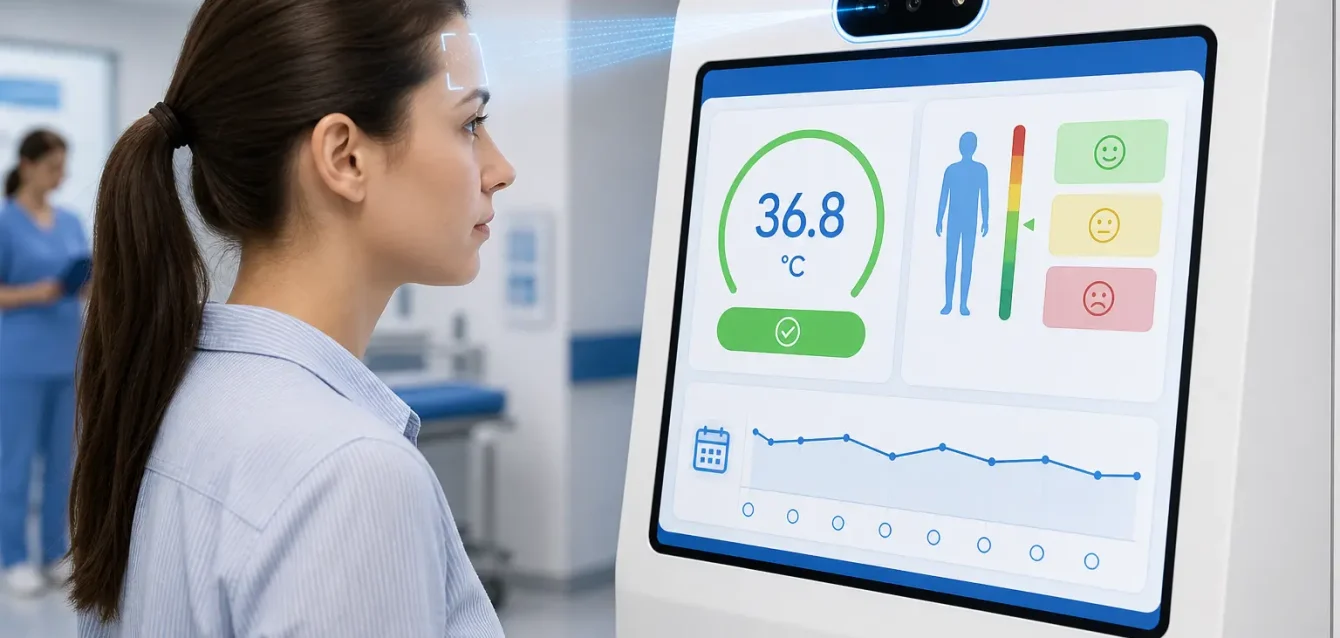
Infrared thermometry enables rapid, non-contact body temperature assessment through detection of thermal radiation emitted from the skin surface, tympanic membrane, or forehead. Calibrated infrared sensors incorporated within medical POI station hardware provide measurement precision adequate for clinical screening applications while enabling high-throughput assessment without physical contact — a property of particular value in infection control contexts and high-volume public health screening programs.
Artificial intelligence applied to infrared temperature measurements addresses two important limitations of isolated measurements: the confounding effect of ambient temperature variation on peripheral infrared measurements, and the clinical interpretation challenge of borderline temperature values that fall in ranges where fever definition is ambiguous. AI correction algorithms trained on paired peripheral and core temperature measurements can improve the accuracy of non-contact thermometry, while classification models provide probabilistic fever assessment that accounts for measurement uncertainty rather than applying fixed threshold criteria.
Temperature Within the Multi-Parameter POI Assessment
The clinical significance of body temperature is substantially enhanced when interpreted alongside concurrent vital sign parameters acquired during the same medical POI encounter. Elevated temperature combined with elevated heart rate, reduced oxygen saturation, and elevated blood pressure may indicate sepsis physiology — a pattern that AI algorithms trained on sepsis screening criteria can identify with sensitivity superior to individual parameter threshold alerts. This integrative analysis capability is central to the diagnostic value of medical POI platforms, enabling clinical triage intelligence that exceeds what any single measurement modality can provide.
During infectious disease outbreaks, the deployment of AI-enhanced temperature screening through medical POI networks creates a distributed surveillance infrastructure of significant public health value. Real-time aggregation of temperature measurement data across networked POI stations provides epidemiological intelligence on the geographic and temporal spread of febrile illness, enabling early detection of outbreak clustering and supporting targeted public health responses before syndromic surveillance through healthcare facility reporting generates actionable signals.
Conclusion
AI-enhanced body temperature assessment within medical POI platforms transforms one of medicine’s most fundamental measurements from a simple numerical reading into a component of an integrated clinical intelligence assessment. By contextualizing temperature within multi-parameter vital sign profiles, enabling sepsis-pattern recognition, and contributing to population-level infectious disease surveillance through networked data aggregation, thermometry at the medical POI demonstrates how established clinical measurements acquire new dimensions of value within intelligent, connected healthcare infrastructure.