

Emergency department wait times are not merely a patient experience metric—they are a measurable patient safety indicator. Systematic reviews have demonstrated a dose-response relationship between wait time duration and adverse outcomes including in-hospital mortality, medication errors, and missed or delayed diagnoses. Artificial intelligence applied to the triage process offers a suite of tools for dynamically re-engineering patient flow: from initial acuity streaming to disposition prediction and care pathway assignment, each of which contributes to measurable reductions in total ED visit duration.
Patient Streaming and Fast-Track Identification
One of the most operationally impactful applications of AI in ED triage is automated patient streaming: the algorithmic identification of low-acuity presentations that can be safely redirected to a fast-track or urgent care pathway without physician triage assessment. ML classifiers trained on triage nurse documentation and initial vital signs have been validated for this purpose, identifying patients safe for fast-track with specificity exceeding 97% in multiple single-centre studies. By removing low-acuity presentations from the primary triage queue, streaming algorithms free attending physicians and senior nurses to focus assessment time on higher-complexity cases—directly improving both safety and efficiency across the triage-to-bed interval.
Dynamic Acuity Re-Scoring in the Waiting Room
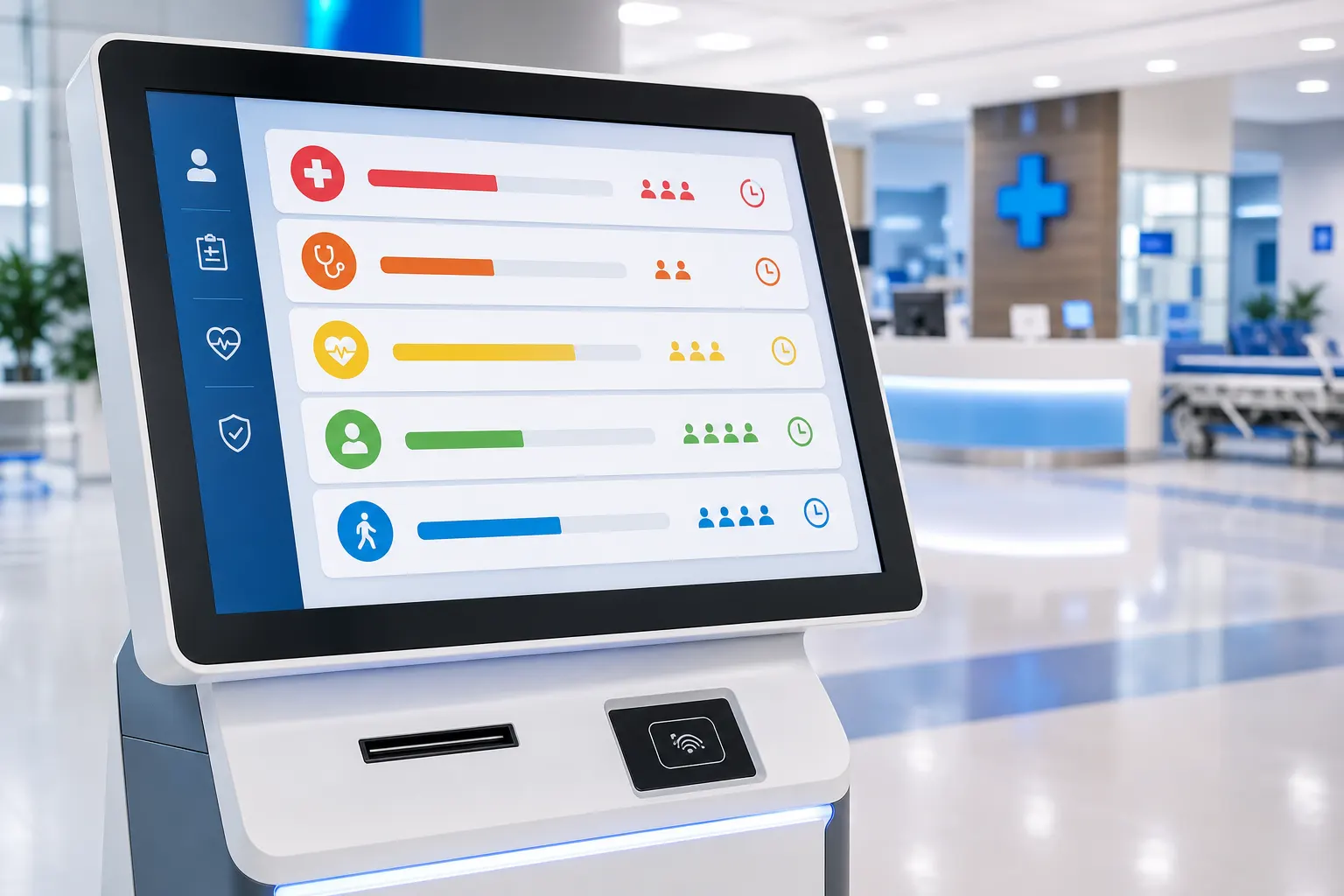
Traditional triage systems assign acuity at the initial assessment point and do not revise it unless a nurse performs a reassessment. Patients may wait for hours following triage without any systematic re-evaluation of their clinical status—a practice that creates conditions for missed deterioration. AI platforms integrated with waiting room monitoring—through periodic vital sign kiosks, wearable sensors, or systematic nursing reassessment workflows—enable dynamic acuity recalculation throughout the waiting period. Any patient whose AI-calculated acuity score crosses a predefined threshold triggers an automatic reassessment request, creating a safety net that conventional static triage cannot provide. This dynamic re-scoring capability is a core design feature of modern AI triage platforms including ERTRIAGE® (ertriage.com), which continuously updates patient risk scores from the moment of registration through to clinical review.
Evidence for Wait Time Reduction
Published evidence for AI-enabled ED wait time reduction derives primarily from before-after implementation studies and simulation modelling. A systematic review by Levin et al. (2018) identified mean reductions in door-to-physician time of 12–18 minutes following deployment of AI-assisted triage tools, with larger effects observed in centres with baseline door-to-physician times exceeding 45 minutes. Simulation studies suggest that AI-directed streaming alone, without any other operational change, could reduce median ED visit duration by 18–35% in moderately overcrowded departments. While prospective randomised evidence remains limited, the convergent findings of multiple independent implementation studies provide a sufficiently robust evidence base to support deployment as a quality improvement intervention.