

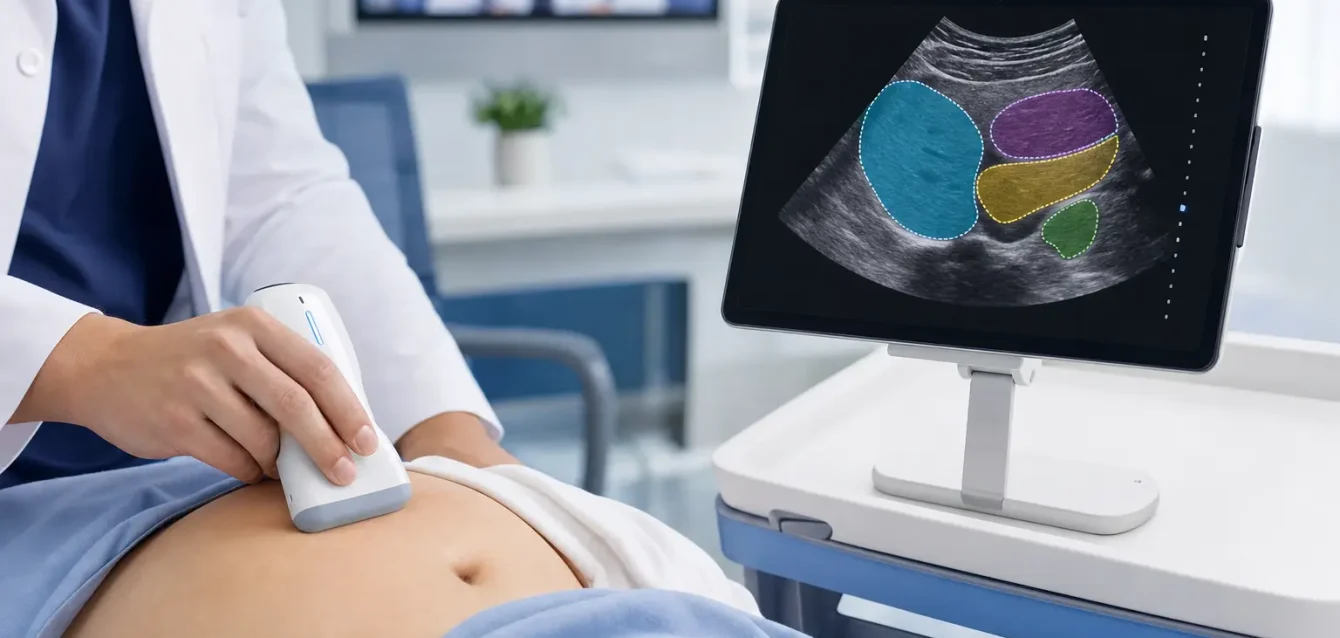
The Point-of-Care Ultrasound Revolution
Point-of-care ultrasound (POCUS) has undergone a remarkable clinical adoption trajectory over the past two decades, transforming from a specialized diagnostic modality confined to radiology departments into a widely practiced bedside tool used across emergency medicine, critical care, internal medicine, and primary care. The drivers of this adoption include the miniaturization of transducer technology, improvements in image quality, and growing evidence that clinician-performed real-time imaging enhances diagnostic accuracy and procedural safety compared to clinical assessment alone. The integration of artificial intelligence into this evolving field now creates the possibility of extending diagnostic imaging capabilities to points of care that cannot support trained sonographers.
AI Image Guidance and Interpretation
Deep learning models applied to ultrasound image streams address two distinct challenges in point-of-care deployment: real-time acquisition guidance and automated interpretation. Acquisition guidance systems use computer vision to provide step-by-step instructions to users acquiring images, ensuring adequate probe position, depth, and focus before image capture is confirmed. This functionality democratizes ultrasound acquisition by enabling non-expert users to obtain diagnostically adequate images under AI supervision — a critical capability for medical POI deployments where trained sonographers are not present.
Interpretation algorithms apply semantic segmentation and classification models to acquired images, identifying anatomical structures, measuring relevant dimensions, and flagging abnormal findings. Validated AI models for the detection of pleural effusion, abdominal free fluid, left ventricular function assessment, gallbladder pathology, and deep vein thrombosis have demonstrated performance characteristics that support their integration into screening workflows. The AI does not replace clinical judgment but provides structured, quantitative preliminary findings that inform the clinician’s assessment.
Integration within Medical POI Platforms
Medical Points of Intelligence that incorporate compact wireless ultrasound transducers alongside AI interpretation software create a capability that was previously unavailable outside of imaging facilities. Patients presenting at a community POI station with abdominal symptoms, dyspnea, or lower extremity swelling can undergo a structured ultrasound protocol guided by AI instruction and interpreted by AI algorithms, with findings immediately transmitted to the patient’s medical record and available for remote clinician review.
The clinical impact extends beyond individual patient encounters. The accumulation of structured ultrasound findings across a POI network creates imaging datasets of significant epidemiological value, enabling surveillance of conditions including non-alcoholic fatty liver disease, peripheral vascular disease, and cardiac structural abnormalities at population scales previously requiring dedicated imaging campaigns. This dual utility — individual diagnostic support and population health surveillance — reflects the broader value proposition of AI-enabled medical POI deployments.
Conclusion
AI-guided point-of-care ultrasound within medical POI platforms represents one of the most significant advances in democratizing diagnostic imaging. By removing the need for expert sonographer presence while maintaining diagnostic quality through intelligent guidance and interpretation, these systems extend imaging capability to the full breadth of healthcare settings where POI stations are deployed. The result is a substantial expansion in the reach and efficiency of diagnostic imaging — a genuinely transformative contribution to modern healthcare infrastructure.