

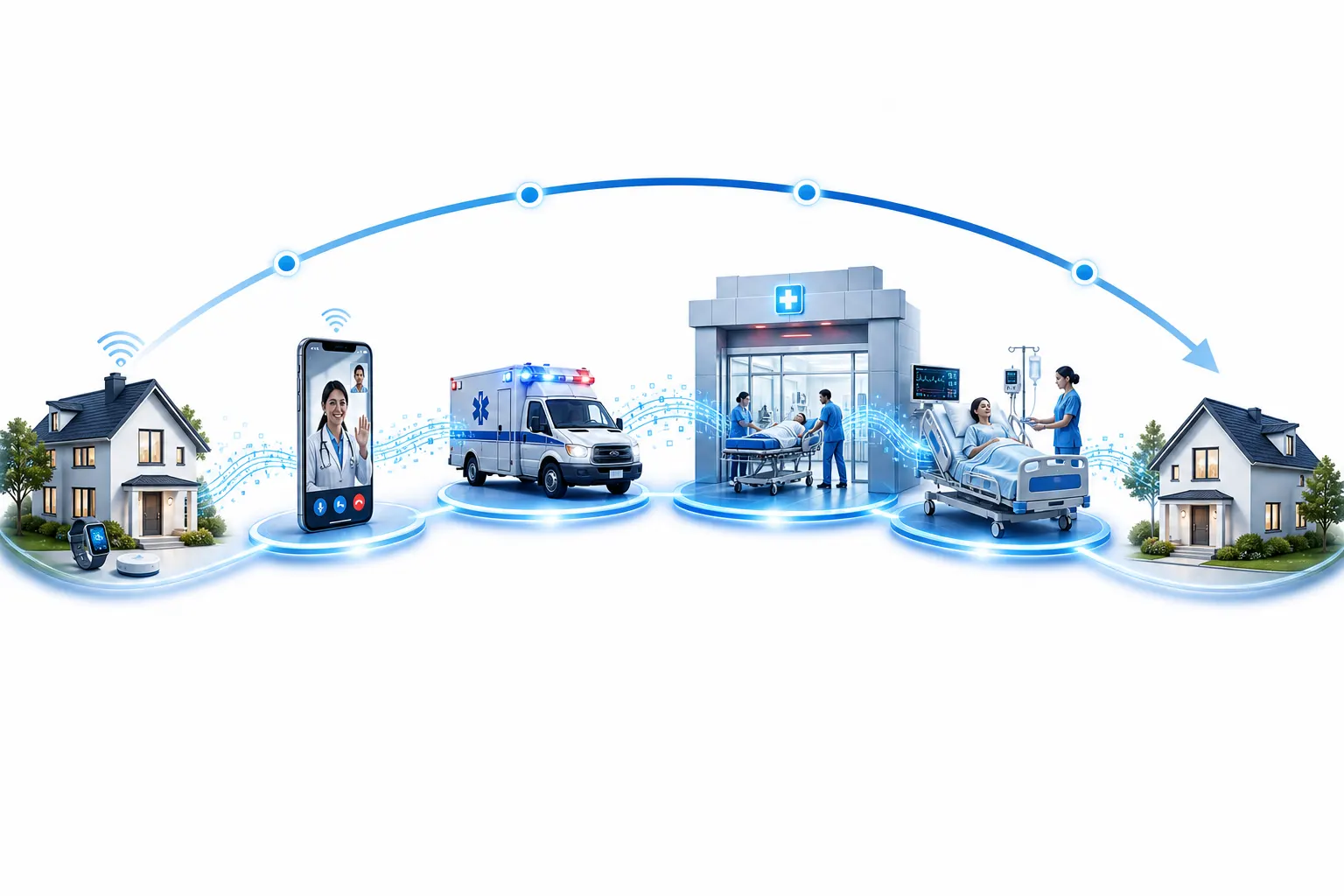
The aspiration of integrated healthcare—care that is continuous, contextualised, and patient-centred across settings and time—has been articulated in health policy for decades without achieving operational reality in most health systems. The structural barriers are well-documented: fragmented information systems, organisational siloes, reimbursement structures that incentivise episodic encounters over longitudinal management, and the technical complexity of connecting heterogeneous clinical platforms across care settings. Artificial intelligence, combined with connected health technologies and unified patient health records, is now providing the technical and informational infrastructure to realise this integrated vision—creating a genuinely continuous patient journey in which every clinical encounter is informed by and contributes to a single, evolving, AI-enriched patient record.
Stage One: Daily Vital Measurement at Home
The patient journey begins at home, where continuous AI-powered monitoring captures the longitudinal physiological baseline that makes all subsequent clinical encounters more accurate. Wearable sensors and home health IoT devices stream vital sign data—heart rate, SpO2, blood pressure, respiratory rate, ECG, physical activity—to the TELECARE® platform, which applies AI models to distinguish normal daily variation from clinically significant trends. This continuous monitoring serves dual functions: it generates an early warning system that detects deterioration before it becomes symptomatic, and it builds a richly annotated physiological baseline against which future acute presentations can be accurately contextualised. A patient whose heart rate has been consistently 62–68 bpm for six months presents a very different clinical picture at triage with a heart rate of 110 than a patient with no monitoring history and the same presenting rate.
Stage Two: Medical Folder as the Intelligence Core
All clinical data—home monitoring trends, telemedicine consultation records, community healthcare encounters, prescribed medications, allergy records, diagnostic imaging, and laboratory history—is consolidated in the MEDPOI® medical folder: the longitudinal patient record that serves as the intelligence core of the patient journey. The medical folder is not a passive data repository but an active AI system that continuously synthesises its contents, updating a structured patient clinical profile that reflects the current known state of the patient’s health, risk factors, active conditions, and monitoring trends. This living clinical document travels with the patient across care settings—accessible to the GP at a community consultation, the paramedic via a pre-alert interface, and the emergency clinician at triage—ensuring that no encounter begins in a data vacuum.
Stage Three: Emergency Triage with Full Context
When a patient requires emergency care, ERTRIAGE® (ertriage.com) receives not merely the presenting vital signs but the full context of the preceding days and weeks from the MEDPOI® medical folder: home monitoring trends, recent telemedicine consultations, current medications, chronic condition burden, and any active clinical concerns flagged by the monitoring AI. The triage acuity score is calculated against this enriched data set rather than the sparse information available in a conventional triage encounter, producing a more accurate risk stratification and an immediately actionable clinical picture. The entire CAREPOI® ecosystem—TELECARE® for continuous home monitoring, MEDPOI® for medical record orchestration, and ERTRIAGE® for emergency triage intelligence—functions as an integrated continuum of care AI rather than as three separate tools, realising the patient journey vision in which the right clinical information is available to the right clinician at the right moment across every stage of the care pathway.