

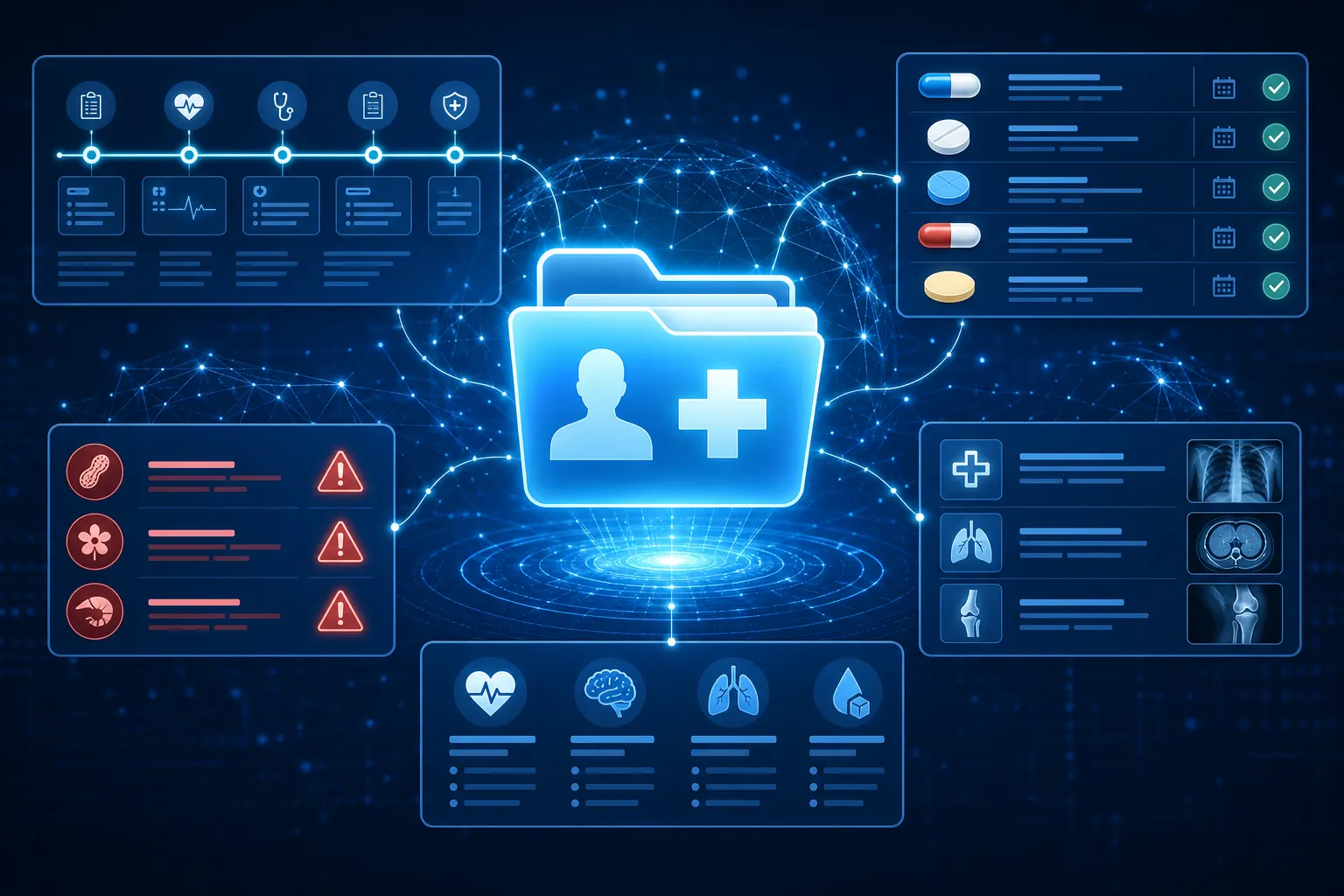
Every emergency patient arrives with a clinical history that fundamentally shapes the interpretation of their presenting complaint, the appropriate diagnostic investigation, and the safe choice of treatment. Chronic conditions alter physiological baselines; current medications interact with emergency treatments; previous investigations establish reference values against which new results must be contextualised; documented allergies define absolute contraindications that must be visible at the moment of prescribing. In the ideal emergency care scenario, this longitudinal patient history is instantly and completely available to the triage clinician from the moment of patient arrival. Artificial intelligence applied to medical records management makes this ideal operationally achievable.
The Medical Folder as a Living Clinical Document
A patient’s medical folder—the accumulated record of their encounters with the healthcare system—is vastly more clinically valuable than any individual data element it contains. A presenting SpO2 of 91% is critical in a patient with no respiratory history and alarming in a patient with known severe COPD and a documented baseline of 89%; the difference is clinically decisive. AI-powered medical records platforms treat the longitudinal health record not as a passive archive but as an active clinical input, continuously synthesising new data against historical context to generate a dynamic patient summary that evolves with each new data point. MEDPOI® (medpoi.com) is specifically architected around this philosophy: the medical folder is the persistent clinical intelligence layer that accompanies the patient across all care settings—home monitoring via TELECARE®, community care encounters, and emergency department presentations via ERTRIAGE®—ensuring complete contextual continuity regardless of where in the healthcare system the patient presents.
AI Summarisation at the Point of Emergency
The practical challenge of the medical folder in the emergency setting is not data availability but data volume: a patient with a complex chronic disease burden may have thousands of clinical notes, hundreds of laboratory results, and dozens of imaging studies accumulated over years of healthcare interactions. Presenting this undifferentiated data mass to a triage clinician managing multiple simultaneous high-acuity patients is clinically impractical. AI summarisation models—trained to extract the most clinically relevant elements from a longitudinal record and present them in a structured, prioritised format appropriate to the presenting complaint—address this challenge by converting data volume into clinical insight. A patient presenting with chest pain receives an AI-generated summary highlighting their last troponin values, echocardiographic findings, current antiplatelet therapy, and known coronary history; a patient presenting with confusion receives a summary oriented to their cognitive baseline, CNS medication history, and any prior neuroimaging. This contextually intelligent summarisation capability is the practical expression of AI medical record integration in the triage environment.