

The Electrocardiogram in Modern Diagnostic Medicine
Since its clinical introduction by Willem Einthoven in the early twentieth century, the electrocardiogram has remained one of the most diagnostically versatile and widely utilized tools in medicine. Its capacity to reveal cardiac rhythm disturbances, conduction abnormalities, ischemic injury patterns, electrolyte derangements, and structural cardiac disease from a non-invasive, real-time measurement makes it uniquely valuable across virtually every clinical context. The challenge in contemporary healthcare is not the diagnostic power of the ECG itself, but the limitations imposed by restricted access — both geographic and professional — to the expertise required for its accurate interpretation.
Machine Learning in ECG Interpretation
The application of deep learning algorithms to ECG interpretation has demonstrated performance levels that equal or exceed those of board-certified cardiologists across a range of diagnostic tasks. Studies employing convolutional neural networks trained on millions of annotated ECG recordings have shown high sensitivity and specificity for the detection of atrial fibrillation, left ventricular hypertrophy, ST-segment elevation patterns consistent with acute myocardial infarction, and rare but clinically critical conditions including Brugada syndrome, long QT syndrome, and hypertrophic cardiomyopathy.
Particularly remarkable are demonstrations that AI ECG analysis can identify pathological states that are not conventionally considered electrocardiographic diagnoses — including left ventricular systolic dysfunction, hyperkalemia, and pulmonary hypertension — by detecting subtle morphological patterns that human interpreters reliably overlook. These capabilities substantially expand the diagnostic utility of the ECG beyond its traditional indications.
ECG Acquisition at Medical POI Stations
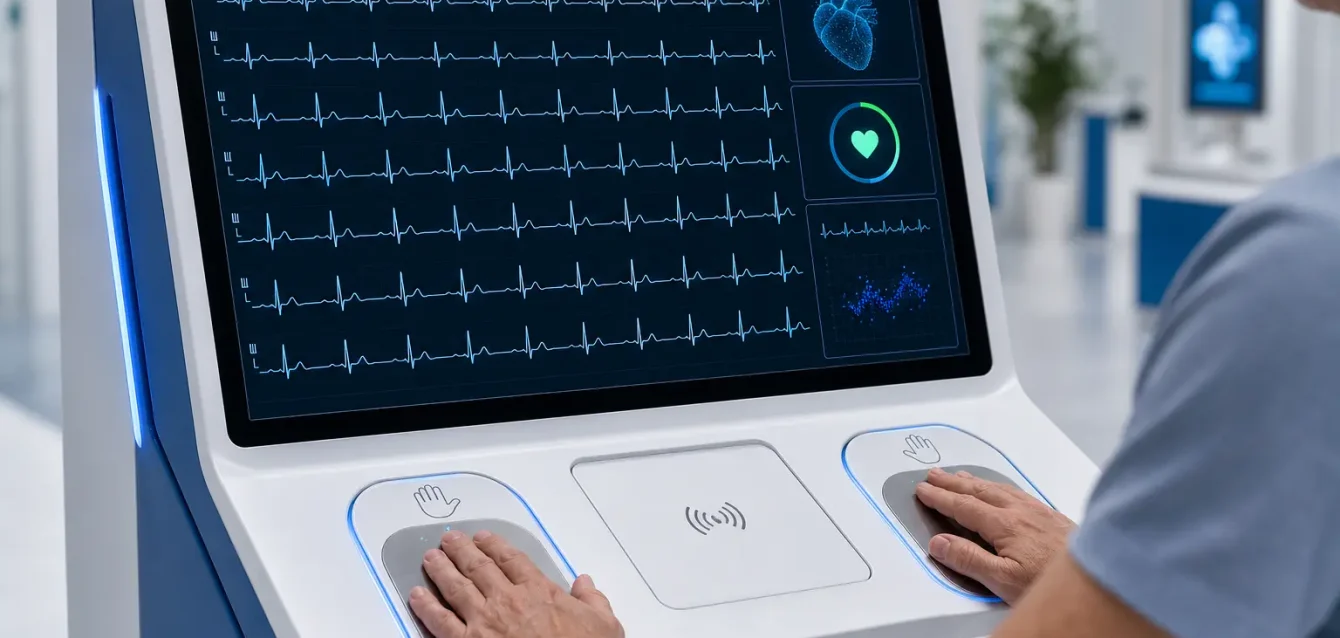
The integration of certified ECG acquisition hardware within medical Points of Intelligence enables 12-lead quality recordings to be obtained at locations far removed from cardiology departments or emergency facilities. Electrode contact systems embedded within the POI surface or provided as clip-based accessories allow patients to perform self-administered recordings under software-guided instruction, with AI-based quality assessment rejecting inadequate recordings before interpretation proceeds.
The AI interpretation engine generates a structured clinical report within seconds of acquisition completion. The report includes rhythm characterization, interval measurements, axis determination, and flagging of any findings warranting urgent clinical review. Critically, all findings are transmitted immediately to the patient’s integrated medical record, where they become accessible to authorized clinicians who may initiate remote review, request follow-up assessment, or trigger emergency care pathways when findings indicate acute cardiac events.
Impact on Emergency Cardiac Care Pathways
The availability of pre-hospital or community-acquired 12-lead ECG data transforms emergency cardiac care pathways in several important ways. When patients with acute chest pain or palpitations attend a medical POI station prior to hospital presentation, the resulting ECG provides emergency departments with preliminary cardiac electrical data that can accelerate triage decisions and reduce time-to-reperfusion in cases of ST-elevation myocardial infarction. Systematic programs that incorporate POI-acquired ECG data into emergency workflows have the potential to reduce door-to-balloon times and improve outcomes in time-sensitive cardiac emergencies.
Conclusion
AI-enabled ECG analysis integrated within medical POI platforms represents a transformative extension of cardiology’s most fundamental diagnostic tool. By combining accessible hardware with validated interpretation algorithms and seamless clinical data integration, these systems democratize cardiac assessment, reduce diagnostic delays, and create a surveillance infrastructure capable of detecting life-threatening cardiac pathology at the community level. The integration of AI ECG capabilities within distributed medical intelligence platforms is a central pillar of modern preventive and emergency cardiology.