

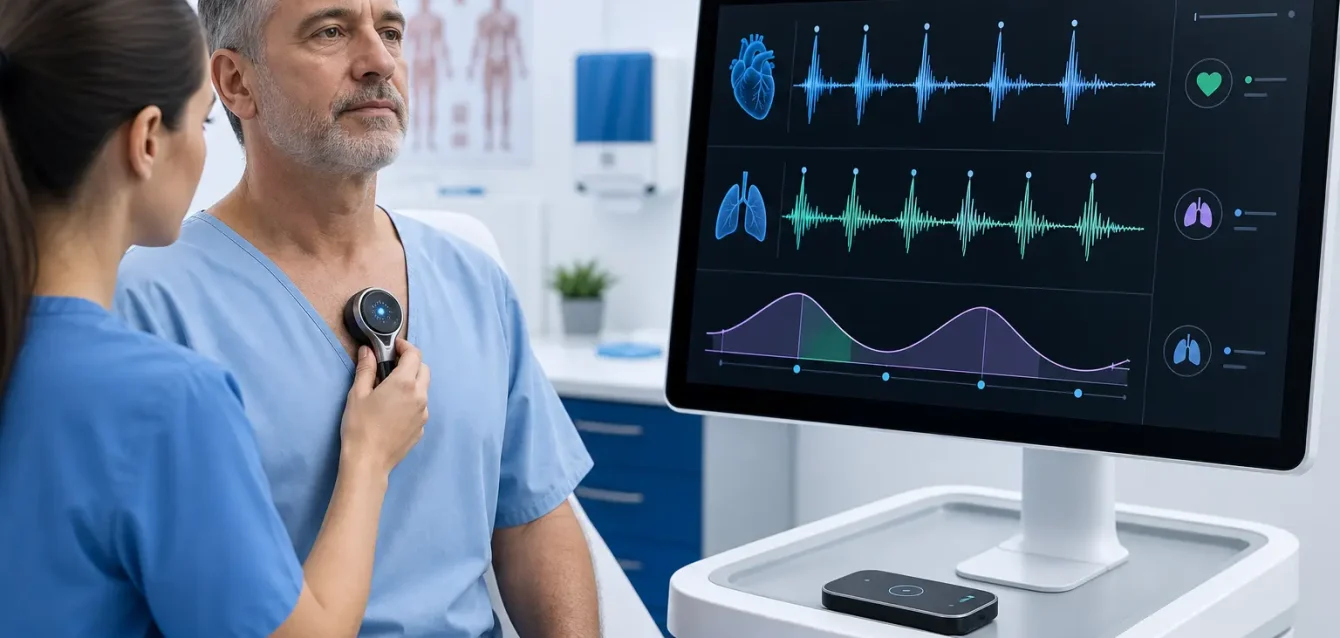
Auscultation in the Age of Artificial Intelligence
Clinical auscultation — the assessment of body sounds using a stethoscope — has been a cornerstone of physical examination for over two centuries. Despite its long history, conventional auscultation is subject to significant inter-observer variability, is inherently ephemeral (the acoustic experience existing only in the examiner’s perception at the moment of examination), and requires substantial training to achieve reliable proficiency. The development of digital stethoscopes capable of recording high-fidelity acoustic signals, combined with machine learning algorithms for sound analysis, addresses each of these limitations systematically.
Machine Learning Models for Acoustic Analysis
Convolutional neural networks and recurrent neural network architectures applied to phonocardiographic and respiratory sound recordings have demonstrated clinically meaningful performance in the classification of cardiac murmurs, identification of abnormal heart sound characteristics including S3 and S4 gallops, and detection of pathological respiratory sounds including wheeze, crackle, rhonchi, and stridor. These algorithms process acoustic signals as time-frequency spectrograms, extracting structural features that correspond to the physical properties of valvular dysfunction, myocardial relaxation abnormalities, and airway pathology.
The reproducibility of AI-based acoustic analysis is a fundamental advantage over human auscultation. The same algorithm applied to the same recording produces identical output regardless of examiner fatigue, ambient noise compensation, or prior diagnostic bias. This property is particularly valuable in serial monitoring applications, where detection of subtle changes in cardiac or pulmonary sound characteristics may indicate prognostic significance before other clinical indicators of deterioration are apparent.
Digital Stethoscopy Within Medical POI Platforms
Medical Points of Intelligence incorporating digital stethoscope hardware enable acoustic examination to be performed under remote clinician guidance, with real-time audio transmission enabling telemedicine consultation that approaches the quality of in-person auscultation. The AI analysis layer operates concurrently, providing the remote clinician with a structured acoustic assessment that highlights any features of clinical significance identified by the algorithm, ensuring that relevant findings are not overlooked during time-constrained consultations.
The acoustic recordings acquired during each POI encounter are stored within the patient’s medical record alongside AI analysis reports, creating a longitudinal phonocardiographic and respiratory sound archive. This archive enables detection of murmur evolution in patients with known valvular heart disease, monitoring of bronchospasm frequency and severity in asthma and COPD, and early identification of new auscultatory abnormalities in patients with systemic conditions affecting cardiac or pulmonary structure.
Conclusion
The integration of AI-enhanced digital stethoscopy within medical POI platforms represents a significant modernization of one of medicine’s most traditional assessment tools. By transforming ephemeral acoustic events into permanent, analyzed, and integrated clinical data, these systems bring the diagnostic depth of specialist auscultation to every point of care where a medical POI is deployed. This capability advances both individual patient assessment and the longitudinal monitoring of cardiorespiratory health across diverse clinical populations.