

The Global Diabetes Challenge and Monitoring Gaps
Diabetes mellitus, in its various forms, affects approximately 537 million adults globally and is projected to affect 783 million by 2045, according to International Diabetes Federation estimates. The effective management of diabetes depends critically on regular, accurate glycemic monitoring to guide therapeutic decisions and prevent the microvascular and macrovascular complications that drive the condition’s enormous burden of disability and mortality. Despite this imperative, a significant proportion of individuals with diabetes receive inadequate glycemic surveillance — particularly in resource-limited settings and among populations with limited healthcare access.
Contextual Intelligence in Glucose Analysis
A single blood glucose measurement, while clinically informative, acquires far greater diagnostic value when interpreted within a framework of temporal context, patient-specific reference values, and concurrent physiological parameters. The same glucose concentration that represents postprandial normality in one patient may indicate pharmacologically suppressed hyperglycemia in another, or fasting hypoglycemia in a third. Artificial intelligence enables the automated application of individualized interpretive frameworks that account for measurement timing, concurrent medications, recent vital sign patterns, and historical glucose profiles — transforming a simple numerical result into a clinically contextualized assessment.
Machine learning models trained on longitudinal glycemic and clinical datasets can identify patterns predictive of deteriorating glucose control before HbA1c thresholds are reached, enabling proactive therapeutic adjustment rather than reactive management after complications have developed. These predictive capabilities are particularly valuable in pre-diabetes surveillance, where identification of individuals at high short-term risk of progression to type 2 diabetes enables targeted preventive interventions that are most effective when applied early in the metabolic transition.
Glucose Monitoring Within Medical POI Platforms
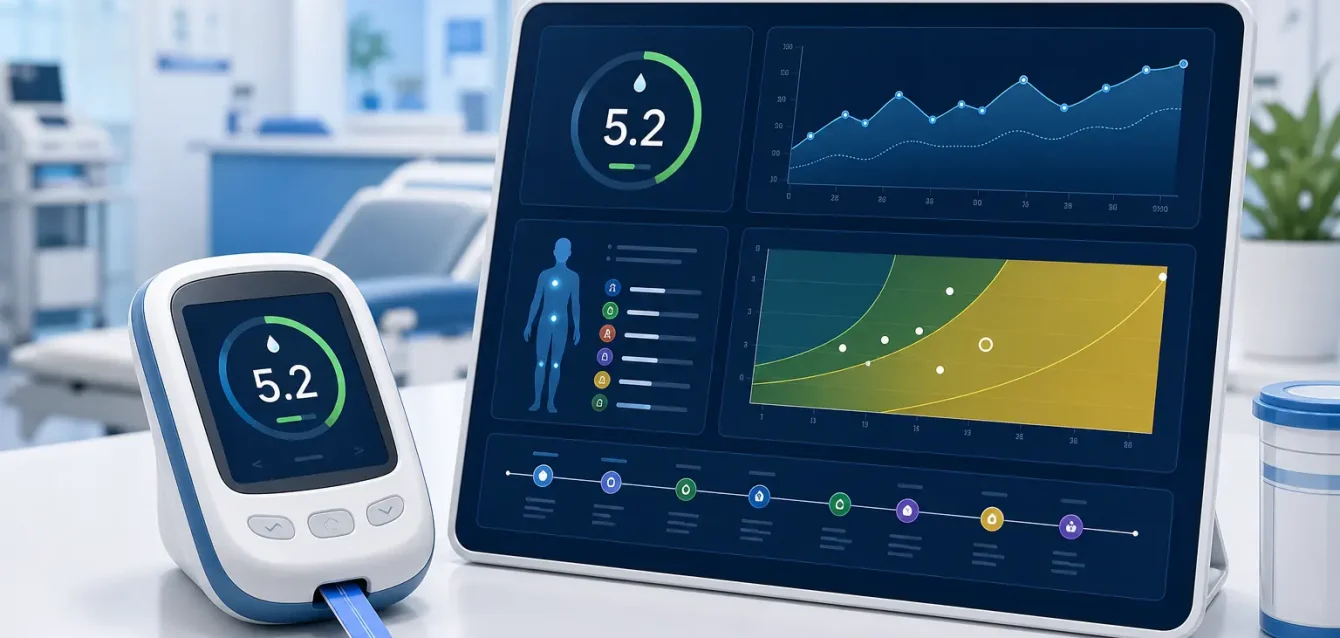
Medical Points of Intelligence incorporating certified blood glucose measurement devices provide a standardized acquisition platform that ensures measurement accuracy while enabling longitudinal data collection across diverse care settings. Each glucose measurement is automatically integrated with concurrent vital sign data acquired during the same POI encounter — blood pressure, pulse rate, oxygen saturation, and body temperature — creating a metabolic-physiological profile that provides the AI analysis system with substantially richer input than glucose measurement alone.
The resulting AI-generated assessment includes not only glucose classification relative to established reference ranges but a contextual risk score that incorporates the full multi-parameter encounter data, patient history, and population-level risk modeling. This comprehensive metabolic intelligence is immediately transmitted to the patient’s medical record and accessible to authorized healthcare professionals for remote review, supporting diabetes management consultation, medication adjustment decisions, and referral for specialist evaluation when indicated.
Conclusion
AI-enhanced blood glucose monitoring within medical POI platforms extends diabetes care beyond the clinical consultation model into a continuous, intelligent metabolic surveillance system. By contextualizing individual measurements within longitudinal patient data and population-level risk models, these systems provide the depth of glycemic intelligence that effective diabetes management requires — accessible at every location where a medical POI station is deployed, at any time patients choose to engage.