

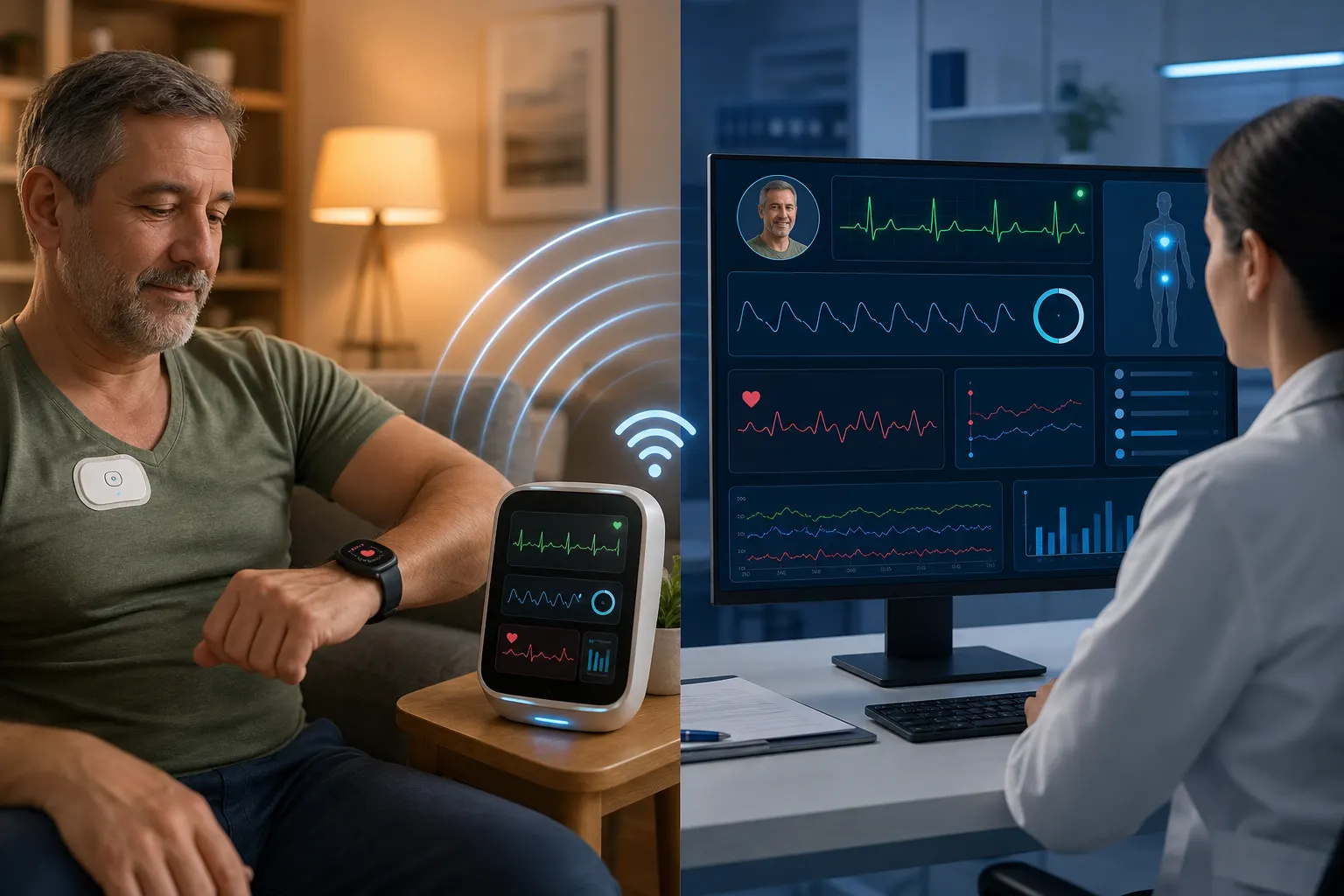
The traditional model of healthcare delivery is episodic: patients interact with the healthcare system at discrete, scheduled intervals, or when acute symptoms prompt an unscheduled presentation. Between these episodes, clinical status is unmeasured—changes in blood pressure, oxygen saturation, cardiac rhythm, weight, or activity level that foreshadow deterioration go undetected until they manifest as symptoms severe enough to trigger a healthcare contact. Remote patient monitoring (RPM) powered by AI and connected wearable technologies fundamentally disrupts this episodic paradigm, enabling continuous, passive clinical observation in the patient’s home environment and transforming the healthcare relationship from periodic episodes to continuous, longitudinal care.
Continuous Vital Sign Surveillance
Contemporary consumer-grade wearables—smartwatches, adhesive patch sensors, implantable loop recorders—are capable of continuous measurement of heart rate, heart rate variability, photoplethysmography-derived SpO2, single-lead ECG, respiratory rate, skin temperature, and activity level. In monitored populations with chronic conditions (heart failure, COPD, atrial fibrillation, hypertension, diabetes), these data streams contain clinically actionable information that, when analysed by AI models trained on large cohorts of wearable + clinical outcome data, enables early identification of deterioration trajectories days before clinical decompensation. Published RPM studies in heart failure populations document 38–53% reductions in 30-day readmission rates when continuous home monitoring AI is integrated with a clinical response pathway. TELECARE® (telecare.com) represents precisely this category of AI-powered continuous monitoring infrastructure, designed to generate clinically meaningful early warning signals from home measurement streams and connect them to the appropriate clinical response—from a telemedicine consultation to an emergency department alert—based on the severity and trajectory of detected changes.
Integration with Emergency Triage
The full clinical value of remote patient monitoring is realised when home monitoring data is seamlessly integrated with the patient’s medical record and emergency triage system. A patient whose TELECARE® home monitoring has detected five days of progressively increasing respiratory rate, declining SpO2 trend, and weight gain consistent with cardiac decompensation carries a fundamentally different clinical picture at emergency triage than a patient arriving with the same presenting vital signs and no monitoring history. The MEDPOI® platform is designed to make this historical context immediately available at the triage encounter: the patient’s monitoring trends are pre-loaded into their medical folder, and the triage AI—powered by ERTRIAGE®—receives this longitudinal data as an additional input to its risk stratification model. The result is a triage system that does not merely evaluate the patient’s current physiological state but interprets it against the trajectory of the preceding days—a fundamentally more clinically accurate basis for acuity assignment.