

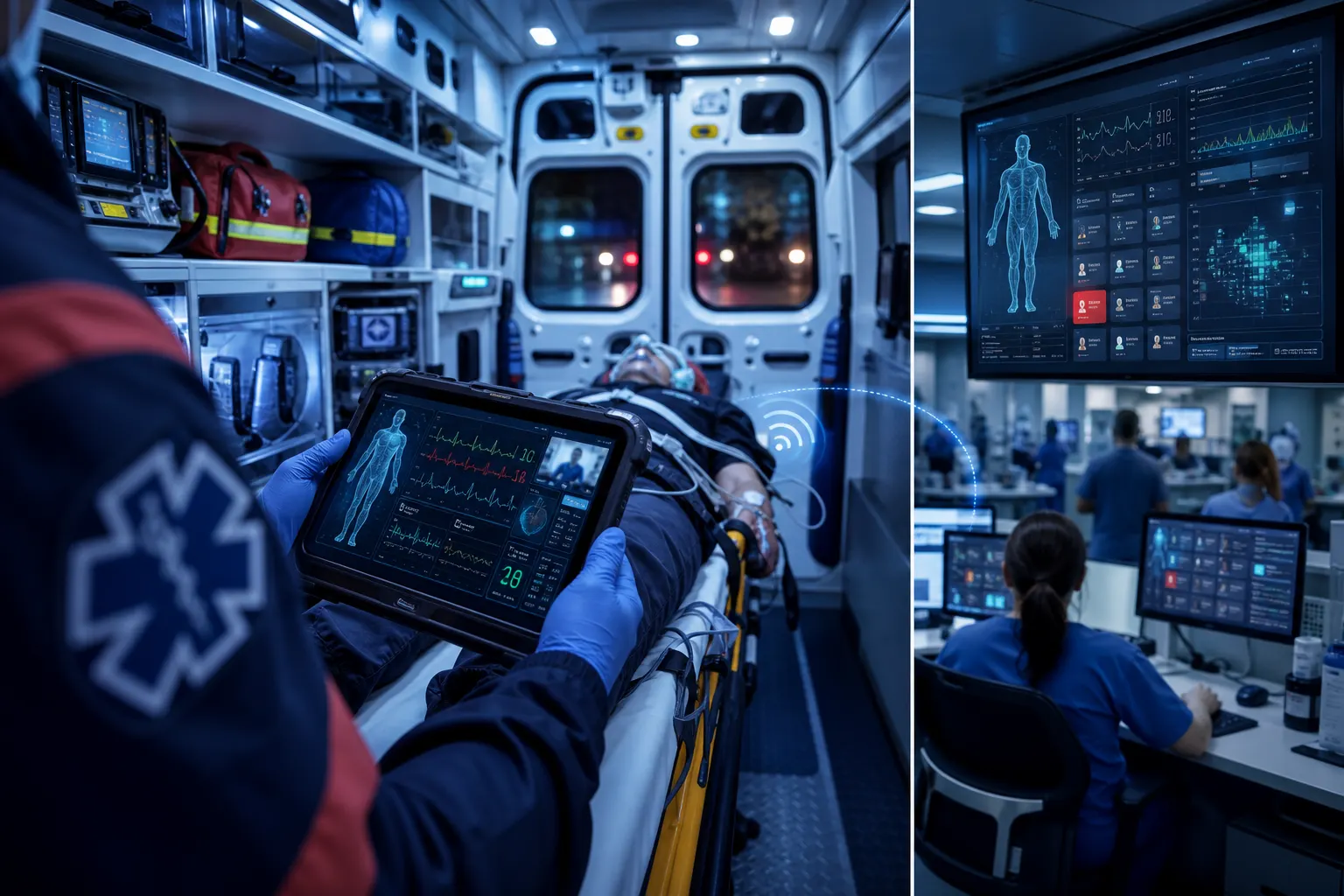
The prehospital phase of emergency care—the period from first responder contact to hospital arrival—represents a clinically critical and technologically underserved interval. For time-sensitive conditions including STEMI, acute ischemic stroke, major trauma, and septic shock, the outcome is significantly determined by events and decisions that occur in the ambulance, before any hospital physician assessment. Artificial intelligence applied to prehospital data streams offers the opportunity to convert this interval from a passive transport phase into an active clinical intelligence window, enabling hospital teams to pre-activate specialist pathways before the patient crosses the hospital threshold.
Real-Time Data Transmission and Pre-Alert Systems
Modern ambulance monitors generate continuous streams of 12-lead ECG, SpO2, non-invasive blood pressure, and capnography data that, until recently, were recorded locally and not transmitted in real time to receiving facilities. 4G/5G-connected monitoring platforms now enable sub-second transmission latency, allowing hospital-based AI systems to begin analysis of prehospital data streams during transport. For STEMI cases, this pre-alert pathway allows the catheterisation laboratory team to assemble before patient arrival, eliminating a substantial portion of the door-to-balloon interval. Studies of early prehospital ECG transmission programmes document median reductions in total ischemic time of 20–40 minutes compared with conventional in-hospital STEMI identification pathways.
Paramedic Decision Support
AI-powered clinical decision support tools designed specifically for the prehospital environment assist paramedics with drug dosing calculations, differential diagnosis generation, and destination decision making—for example, routing major stroke presentations directly to thrombectomy-capable centres rather than the nearest ED. These tools must function in conditions of limited connectivity, time pressure, and with incomplete clinical information—constraints that make lightweight, offline-capable model architectures preferable to cloud-dependent inference pipelines. The integration of prehospital AI assessment outputs into the receiving hospital’s triage system—so that the ED clinician sees the AI-generated prehospital risk score before the patient arrives—is a key design requirement for end-to-end AI clinical pathways. This prehospital-to-hospital data continuity is a distinguishing feature of comprehensive AI triage platforms such as ERTRIAGE® (ertriage.com), which are architected to ingest prehospital data streams as part of a continuous patient record rather than treating hospital arrival as a data reset point.
Evidence and Future Directions
Randomised evidence for prehospital AI decision support is limited, with most published literature deriving from observational cohort studies and retrospective database analyses. The inherent complexity of prehospital care—variable scene circumstances, multi-agency coordination, resource constraints—makes rigorous prospective trial design challenging. Nevertheless, the mechanistic logic for pre-alert AI benefit is well-established, and the consistent direction of observational evidence supports investment in prehospital-to-hospital AI connectivity infrastructure. As autonomous telemedicine capabilities improve and 5G coverage expands, the prehospital phase may evolve from its current status as a data collection interval into a full clinical assessment and treatment initiation phase—fundamentally altering the structure of emergency medical systems.