

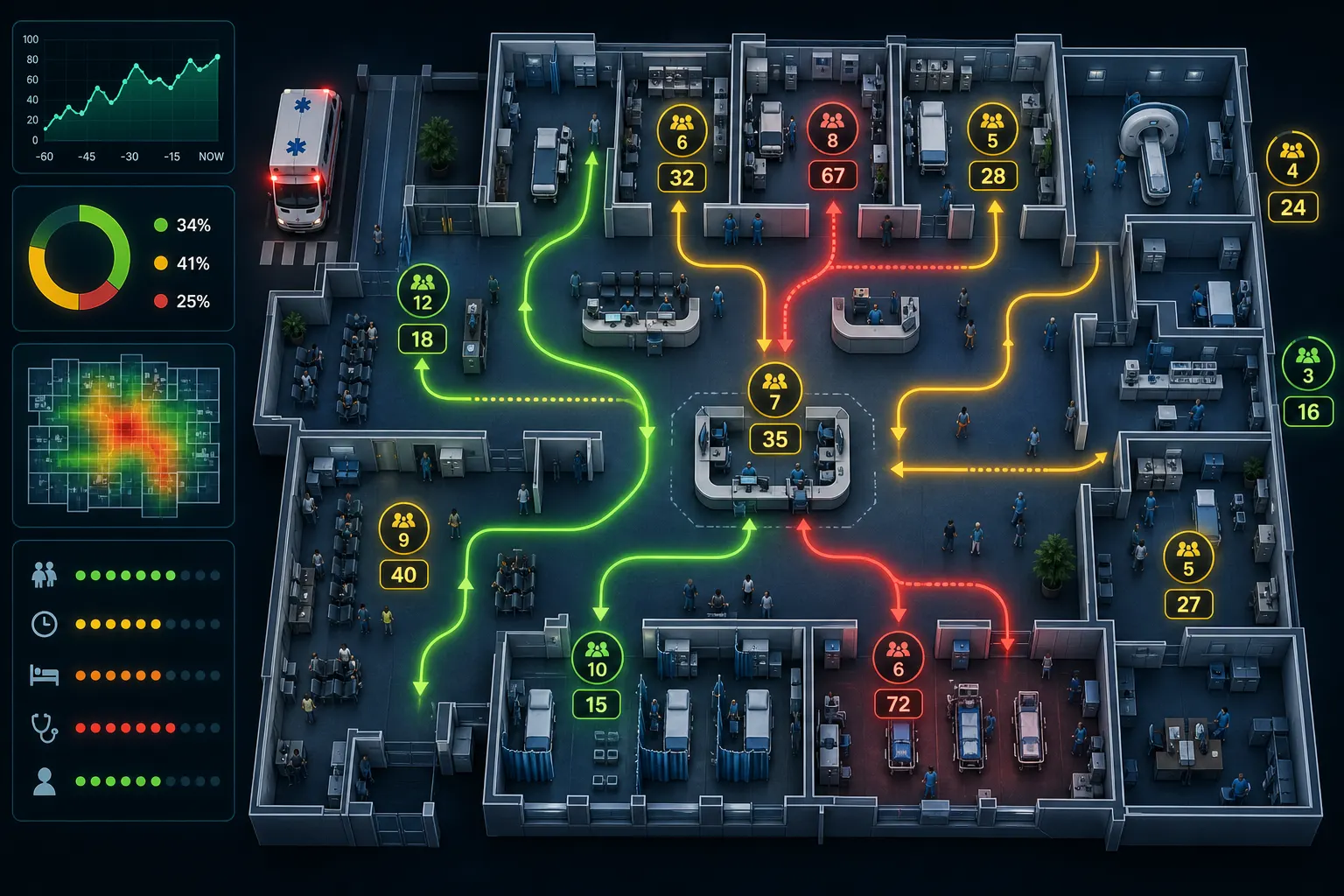
Emergency department overcrowding is consistently identified as one of the leading contributors to adverse patient outcomes, medication errors, and clinician burnout in high-income healthcare systems. Meta-analyses of the overcrowding literature link elevated ED occupancy to increased inpatient mortality, prolonged boarding times, and significantly higher rates of patients leaving without being seen. Predictive artificial intelligence represents a substantive operational tool for addressing this systemic challenge by converting reactive census management into proactive capacity planning.
Forecasting Patient Volume and Acuity Mix
Time-series forecasting models—ranging from classical ARIMA approaches to modern gradient boosted regressors and transformer-based architectures—can predict hourly ED arrival rates with mean absolute errors of five to twelve patients per hour in tertiary centre environments (Afilalo et al., Annals of Emergency Medicine, 2007; Sun et al., Emergency Medicine Journal, 2009). Inputs predictive of volume surges include day-of-week and seasonal patterns, local epidemic surveillance data, weather indices, and nearby scheduled event calendars. Acuity mix prediction—distinguishing the proportion of high-acuity versus ambulatory presentations expected in the next four to eight hours—allows charge nurses to pre-position specialist resources, initiate early bed allocation, and adjust triage nurse staffing ratios in advance of demand peaks.
Length-of-Stay Prediction and Discharge Optimisation
Predicting individual patient length of stay (LOS) at the time of triage enables proactive inpatient bed reservation and reduces the “boarding” phenomenon—the occupation of ED beds by admitted patients awaiting inpatient placement, which is the single most important driver of ED overcrowding. Published ML models for ED LOS prediction achieve mean absolute errors of 60–120 minutes when features include triage acuity, chief complaint category, presenting vital signs, time of arrival, and primary physician assignment. Gradient boosting classifiers trained to identify patients at low risk of hospital admission with high specificity can safely support early discharge pathways, reducing unnecessary diagnostic workup for ambulatory presentations and freeing ED resources for genuinely high-acuity cases.
Integration with Real-Time Triage Systems
The maximal operational benefit of ED flow AI is realised when forecasting models are integrated with real-time triage data streams rather than operating as standalone planning tools. A patient’s predicted LOS and disposition probability, updated continuously as new clinical data is generated, can populate an operational dashboard visible to the charge nurse, bed manager, and medical director simultaneously—enabling coordinated, evidence-based decisions about patient streaming, fast-track activation, and diversion decisions. This integration represents the natural functional boundary between triage AI platforms and hospital operations systems, a boundary that modern emergency AI infrastructure is increasingly designed to bridge.