

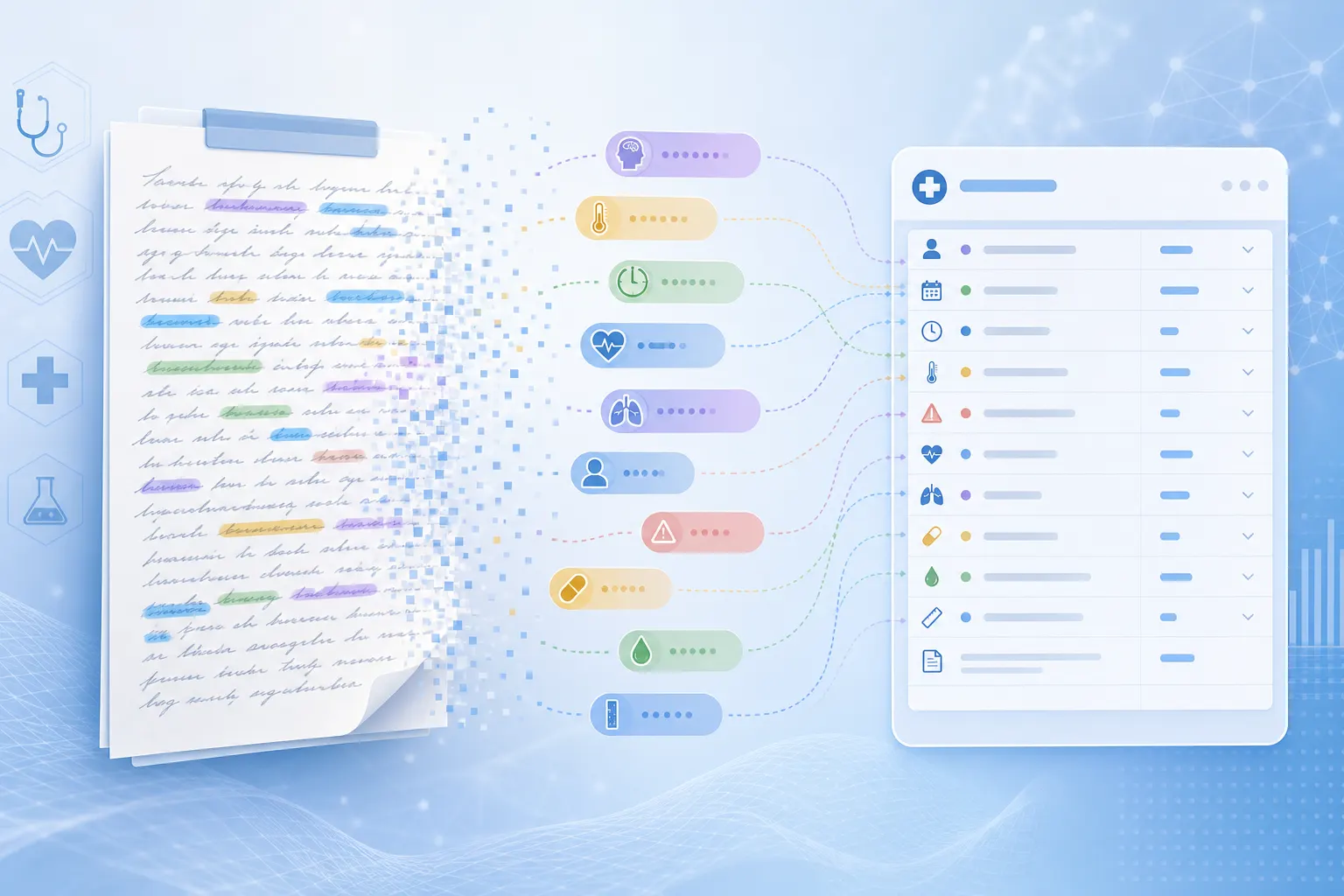
Emergency medicine generates an extraordinary volume of unstructured textual data: chief complaint narratives, nursing triage notes, paramedic handover documentation, and physician assessments. In conventional triage workflows, this information is captured for documentation purposes but is rarely exploited computationally. Natural language processing (NLP)—the branch of artificial intelligence concerned with machine understanding of human language—provides the methodological framework to convert these free-text data streams into structured, machine-readable features that can substantially improve the accuracy and speed of clinical decision support.
Chief Complaint as a Predictive Feature
The chief complaint is the earliest, most consistently available data element at triage. Though brief—typically three to fifteen words—it encodes critical clinical information: symptom type, onset acuity, and frequently the patient’s self-assessment of severity. Bag-of-words and TF-IDF representations of chief complaint text have been used as predictive features in ED triage classifiers for more than a decade (Levin et al., Annals of Emergency Medicine, 2018). Modern transformer-based embeddings (BioBERT, ClinicalBERT, Med-BERT) capture semantic relationships between clinical terms that sparse vector representations miss, enabling the detection of high-acuity presentations couched in atypical or colloquial language—a particularly important capability for paediatric and elderly populations whose symptom descriptions diverge from adult textbook presentations.
Named Entity Recognition for Clinical Coding
Beyond chief complaint processing, NLP pipelines applied to full nursing triage notes can extract named entities including anatomical locations, symptom duration and severity qualifiers, denied symptoms (negation detection), and prior medical history mentions. These structured outputs serve dual purposes: they improve downstream ML classifier performance by expanding the feature space beyond coded vital signs and demographic data, and they reduce the documentation burden on triage nurses by auto-populating structured fields from free-text entry. Emergency AI platforms integrating NLP for automated clinical coding—including purpose-built triage systems like ERTRIAGE® (ertriage.com)—can process a triage note in under 300 milliseconds, making real-time augmentation of the triage decision practically feasible.
Clinical Validation and Multilingual Considerations
Most published clinical NLP models for emergency medicine have been validated on English-language corpora derived from large US academic medical centres. Deployment in multilingual or non-anglophone settings requires language-specific model fine-tuning or the use of multilingual pre-trained models (mBERT, XLM-R), and involves additional validation work to ensure that clinical entity extraction accuracy is preserved across languages. European health systems serving diverse immigrant populations, in particular, face this challenge acutely. Robust clinical NLP for emergency medicine is therefore an active research frontier, with translation and cross-lingual transfer learning representing key methodological priorities for the next development cycle.