

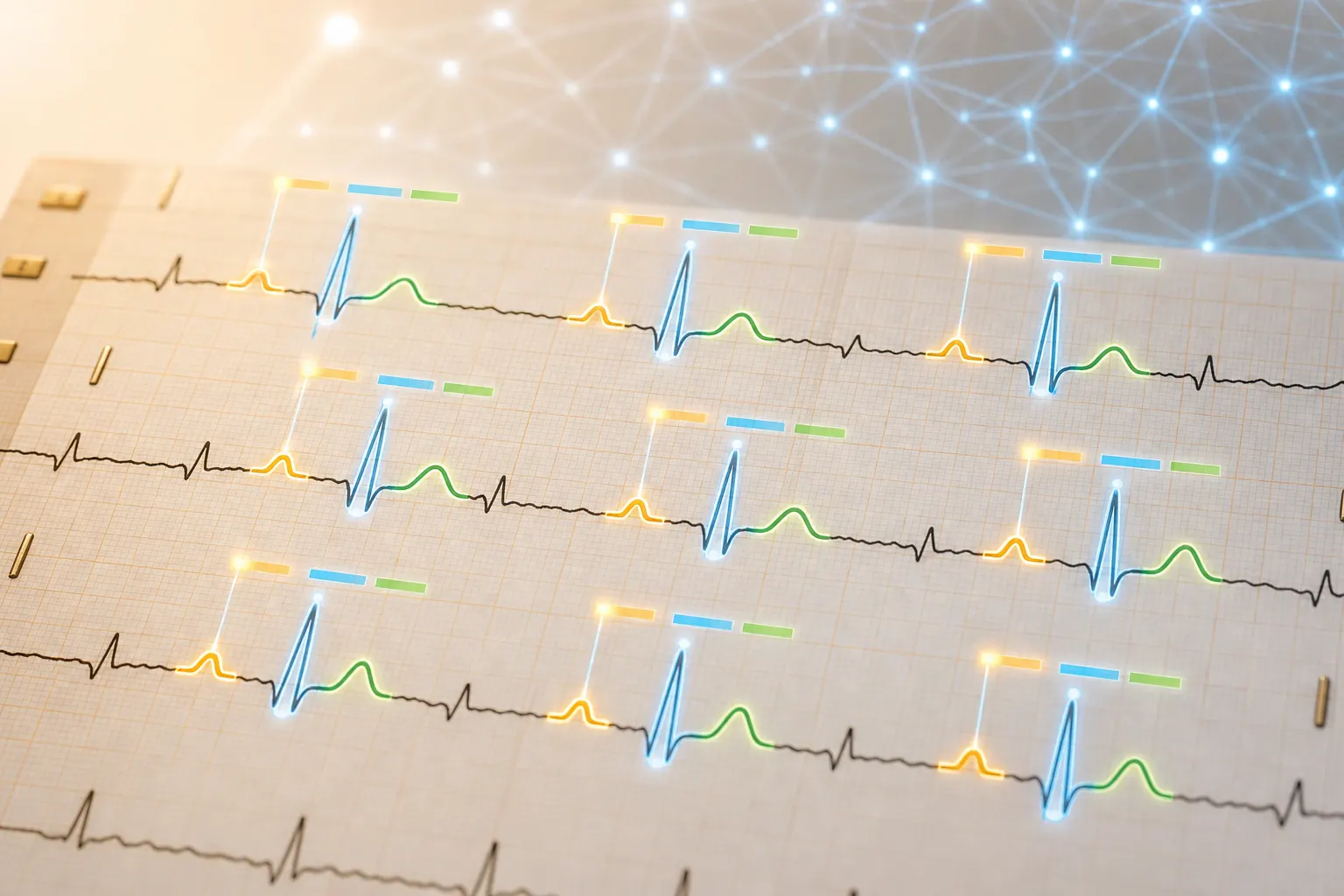
The 12-lead electrocardiogram remains the most rapidly available, high-information-density diagnostic tool in emergency medicine. Its interpretation, however, demands pattern recognition expertise that is unevenly distributed across clinical settings—a disparity with particular impact in rural hospitals, night-shift coverage, and resource-limited healthcare environments. Deep learning models trained on large ECG repositories have now demonstrated cardiologist-equivalent accuracy across a range of clinically important diagnoses, with the additional advantages of instantaneous analysis, freedom from cognitive fatigue, and consistent reproducibility.
Arrhythmia Classification and STEMI Detection
The landmark paper by Rajpurkar et al. (2017) demonstrated that a 34-layer convolutional neural network trained on 91,232 single-lead ECG recordings outperformed board-certified cardiologists on 12-rhythm classification, achieving superior F1 scores for arrhythmias including atrial fibrillation, first-degree AV block, right bundle branch block, and ventricular tachycardia. Subsequent studies of 12-lead architectures have validated similar performance levels for STEMI detection, with sensitivity of 90–95% and specificity of 91–97% reported across external validation cohorts. Critically, AI-detected STEMI triggers the catheterisation laboratory activation sequence without requiring an on-call cardiologist to review the ECG first—compressing the door-to-balloon interval in STEMI pathways by a documented median of 10–23 minutes.
Beyond Acute Diagnoses: Subclinical Detection
Perhaps the most scientifically striking capability of modern ECG AI is the detection of conditions not traditionally considered ECG-diagnosable. Attia et al. (Nature Medicine, 2019) demonstrated that a CNN trained on 180,922 ECGs could detect asymptomatic left ventricular dysfunction with an AUC of 0.93 from a standard 12-lead recording—a finding with profound implications for population-level cardiac screening. Similarly, ECG-based AI models have shown preliminary evidence for detection of hyperkalaemia, atrial fibrillation burden prediction, and even age estimation that may serve as a cardiovascular risk proxy. In the emergency medicine context, these capabilities translate to the potential for a single ECG acquisition at triage to yield a multi-dimensional cardiovascular risk profile, informing both immediate clinical decisions and appropriate follow-up pathways.
Implementation in Clinical Practice
ECG AI has achieved a higher degree of clinical translation than most AI medical applications, with multiple CE-marked and FDA-cleared algorithms available in commercial ECG machines and as software overlays for existing ECG archives. Key implementation considerations include: defining the role of AI output (notification tool versus autonomous diagnosis), establishing physician accountability for the final clinical interpretation, ensuring that AI-positive cases receive expedited rather than parallel physician review, and monitoring false-positive rates prospectively to avoid unnecessary cath lab activations. The integration of ECG AI outputs into the broader ED triage workflow—so that an AI-flagged STEMI automatically populates the patient’s triage record and generates a cardiology alert—exemplifies the connected care pathway that modern AI clinical platforms are designed to enable.