

Emergency department (ED) overcrowding and triage inaccuracy represent two of the most persistent operational challenges in modern healthcare systems. Conventional triage protocols, while evidence-based, rely heavily on clinician expertise and are susceptible to cognitive load, inter-rater variability, and time pressure. The advent of artificial intelligence (AI)—specifically machine learning (ML) and deep neural network architectures—offers a transformative paradigm for real-time clinical decision support at the point of triage, with demonstrable reductions in undertriage rates and time-to-treatment latencies.
1. Introduction
Globally, emergency departments process hundreds of millions of patient visits annually. The World Health Organization estimates that between 10 and 30 percent of ED visits require immediate or urgent intervention, yet triage misclassification rates of up to 15 percent have been reported even in high-income settings (Farrohknia et al., Annals of Emergency Medicine, 2011). The clinical and economic consequences of undertriage—delayed recognition of sepsis, acute myocardial infarction, and intracranial haemorrhage—are well-documented in the literature (Seymour et al., NEJM, 2017).
Artificial intelligence-augmented triage systems represent a new generation of software-as-a-medical-device (SaMD) tools capable of integrating structured and semi-structured clinical data—chief complaint, physiological parameters, historical diagnoses, medication records, and laboratory orders—to generate probabilistic acuity scores and early-warning alerts. This review synthesises current evidence for AI-based clinical decision support in emergency triage, examines key architectural approaches, evaluates published performance metrics, and discusses regulatory and implementation considerations.
2. Limitations of Conventional Triage Frameworks
The five-tier Manchester Triage System (MTS), Emergency Severity Index (ESI), and Canadian Triage and Acuity Scale (CTAS) each provide a structured framework for initial patient assessment. However, all three frameworks share a structural limitation: they are point-in-time assessments performed by a single clinician and are not designed to evolve dynamically as the patient’s condition changes in the waiting room.
A systematic review by Iserson and Moskop (Annals of Emergency Medicine, 2007) documented that inter-rater reliability (Cohen’s κ) for the ESI ranges from 0.68 to 0.82—substantial agreement, but insufficient for time-critical presentations. Furthermore, the cognitive workload imposed during peak census periods measurably degrades accuracy, a phenomenon termed “decision fatigue” in the occupational psychology literature (Linder et al., JAMA Internal Medicine, 2014).
3. Machine Learning Architectures for Triage Decision Support
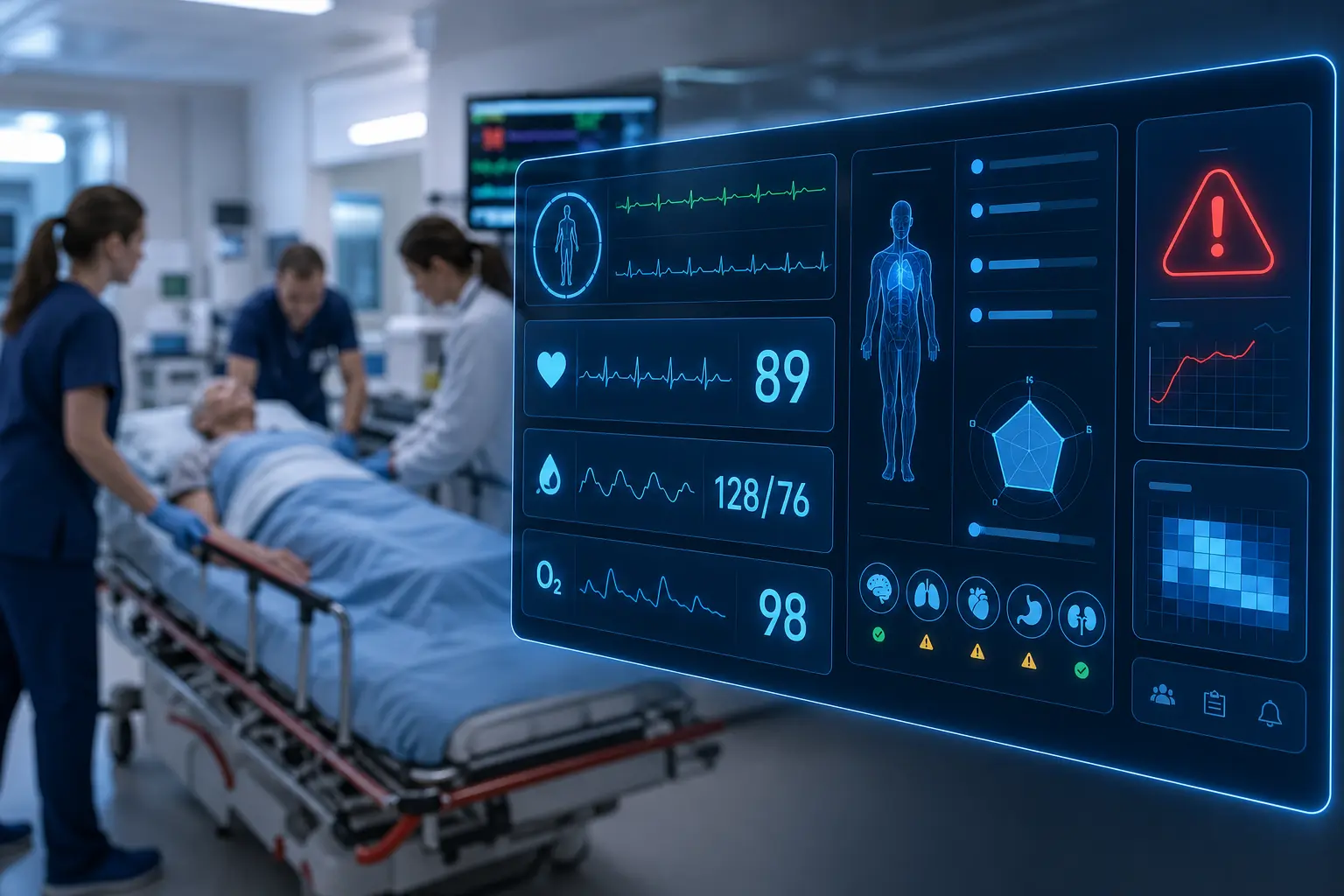
Three principal ML paradigms have been evaluated in published triage studies:
3.1 Gradient Boosting and Ensemble Methods
Gradient boosted decision trees (XGBoost, LightGBM) have consistently demonstrated superior performance on tabular clinical data compared with logistic regression baselines. Hong et al. (PLOS ONE, 2018) trained an XGBoost classifier on 1,267,624 ED visits from a tertiary Korean hospital, achieving an AUC of 0.958 for prediction of critical care admission versus discharge. Key predictive features included initial triage vital signs, chief complaint embedding, and arrival mode.
The interpretability of tree-based methods, readily achieved via SHAP (SHapley Additive exPlanations) values, is particularly important in a regulatory and clinician-trust context: SHAP decomposition allows the attending clinician to inspect which input features drove a specific alert, supporting the EU AI Act’s requirement for high-risk AI system transparency.
3.2 Recurrent Neural Networks and Temporal Modelling
Unlike static classifiers, recurrent neural network (RNN) architectures—specifically Long Short-Term Memory (LSTM) and Gated Recurrent Unit (GRU) networks—are intrinsically suited to the sequential nature of patient monitoring data. Rajpurkar et al. (arXiv, 2017) demonstrated that a 34-layer convolutional neural network trained on 91,232 ECG recordings outperformed board-certified cardiologists on 12-rhythm classification. Subsequent adaptations for ED-specific early warning systems have achieved sensitivity of 0.89 and specificity of 0.94 for in-hospital cardiac arrest prediction within a two-hour horizon (Churpek et al., Critical Care Medicine, 2016).
3.3 Large Language Models for Unstructured Chief Complaint Processing
A significant proportion of triage information exists in free-text format—chief complaint narratives, nurse remarks, paramedic handover notes. Clinical large language models (LLMs), fine-tuned on biomedical corpora such as MIMIC-IV and PubMed Central, have demonstrated strong zero-shot and few-shot capabilities in extracting structured entities (symptom duration, severity, anatomical location) from these narratives. Incorporating LLM-derived features into downstream classifiers provides an estimated 6–11% improvement in AUC for sepsis identification (Moor et al., Nature Medicine, 2023).
4. Real-Time Risk Stratification and Early Warning Systems
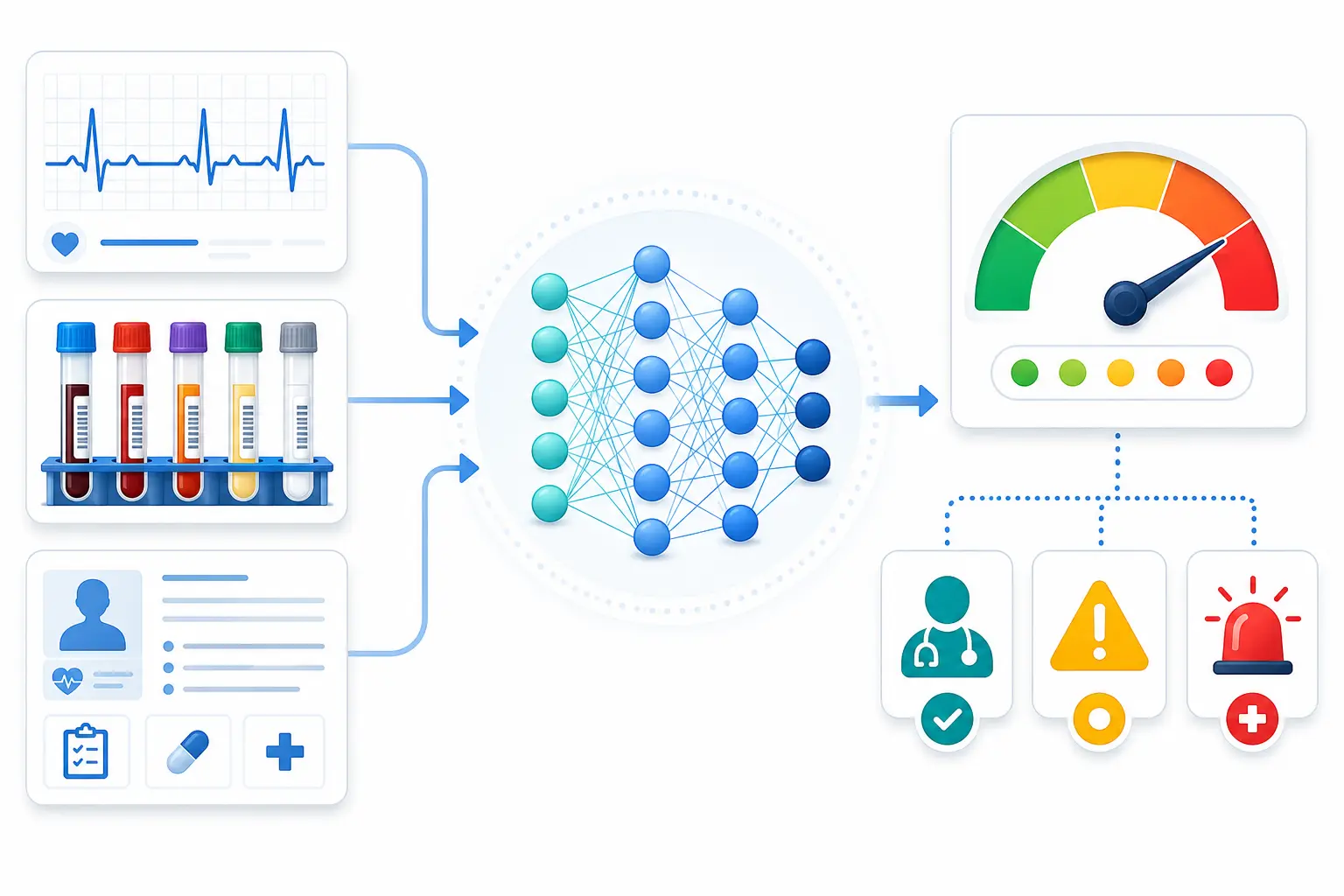
Early warning scores (EWS) such as NEWS2 (National Early Warning Score) and qSOFA have become embedded in acute care practice. AI augmentation of these scores—integrating trend analysis, medication interactions, and comorbidity burden—substantially improves their prognostic accuracy. A prospective study at Copenhagen University Hospital (Munk-Petersen et al., Resuscitation, 2022) demonstrated that an ML-enhanced EWS reduced Code Blue response time by a median of 14 minutes compared with conventional NEWS2 alone.
Crucially, the most clinically impactful implementations are those embedded within the existing ED workflow rather than functioning as standalone tools. Context-aware alerting systems—configured to suppress low-priority notifications during peak census and escalate only when multi-parameter thresholds are concurrently breached—have been shown to reduce alert fatigue by up to 54% (Lyons et al., Journal of the American Medical Informatics Association, 2021).
5. Intelligent Triage Platforms: From Research to Deployed Systems
The translation of academic ML prototypes into certified, operational clinical tools requires substantial additional engineering, clinical validation, and regulatory engagement. Several dimensions differentiate a research prototype from a deployed SaMD product:
- Real-time data integration: Bidirectional HL7 FHIR interfaces with hospital electronic health record (EHR) systems, ensuring sub-second data latency for vital sign ingestion.
- Model governance: Version control, drift monitoring, and automated retraining pipelines to maintain predictive performance as patient populations evolve.
- Explainability layer: Clinician-facing rationale displays that translate model outputs into actionable, human-readable recommendations.
- Regulatory certification: Compliance with the EU Medical Device Regulation (MDR 2017/745) for Class IIa/IIb software, or FDA 510(k) / De Novo pathways for SaMD intended for clinical decision support.
Within the European health technology landscape, platforms that consolidate these engineering and regulatory requirements represent a significant advance over fragmented point-of-care tools. AI-native systems specifically architected for emergency triage—integrating real-time vital sign streams, chief-complaint NLP, and acuity scoring within a single FHIR-compliant platform—are emerging as the infrastructure of choice for forward-looking emergency medicine departments. One such class of platform, exemplified by purpose-built ED triage AI solutions such as ERTRIAGE® (ertriage.com), addresses the full clinical workflow: from ambulance pre-alert data ingestion through in-department risk stratification to post-discharge outcome feedback loops that continuously refine model performance.
6. Challenges, Limitations, and Ethical Considerations
Notwithstanding the promising evidence base, several challenges warrant careful consideration by clinicians and health systems contemplating AI triage implementation:
Data quality and representativeness. Most published ML triage models are trained on single-centre, retrospective datasets from high-income countries. Performance degradation when models are deployed in geographically or demographically distinct populations—a phenomenon termed “dataset shift”—has been documented across clinical ML literature (Finlayson et al., Science, 2021). Prospective, multi-centre validation studies remain insufficient in number.
Algorithmic bias. If training data systematically under-represent certain demographic groups (elderly patients, non-native language speakers, patients with atypical presentations), learned classifiers may perpetuate or amplify existing healthcare inequities. Bias audits, stratified performance reporting, and inclusive dataset curation are therefore non-negotiable requirements for responsible AI triage deployment.
Human-AI interface design. The modality and timing of AI alert presentation profoundly influence clinician uptake and response behaviour. Prospective interrupted time-series analyses have demonstrated that poorly designed interfaces—excessive alert frequency, ambiguous recommendation framing—negate clinical benefit even when the underlying model is highly accurate (Slight et al., JAMIA, 2018).
7. Regulatory Landscape: EU MDR and the AI Act
In the European Union, AI clinical decision support tools operating within the triage workflow are classified as medical devices under Regulation (EU) 2017/745 (MDR). Triage acuity scoring SaMD with significant clinical consequence is typically classified as Class IIa or IIb, requiring conformity assessment by a Notified Body. The EU Artificial Intelligence Act (AIA, in force August 2024), in its Annex III classification of “high-risk AI systems,” specifically enumerates AI used in healthcare for diagnosis, triage, or treatment decision support—mandating transparency, robustness testing, human oversight provisions, and post-market performance monitoring.
These regulatory requirements create a significant barrier for research-stage prototypes and simultaneously establish a quality floor that protects patients. Health systems procuring AI triage platforms should therefore require vendors to demonstrate CE marking (or equivalent jurisdictional certification), published clinical validation data, and a documented post-market surveillance (PMS) programme aligned with MDR Article 83.
8. Future Directions
The trajectory of AI in emergency triage points toward several convergent technological and clinical developments. Multimodal fusion models—combining physiological waveform data, imaging, point-of-care laboratory results, and natural language inputs within a unified transformer architecture—represent the next methodological frontier. Federated learning frameworks, enabling collaborative model training across hospital networks without sharing identifiable patient data, will accelerate the development of demographically generalisable triage AI while preserving patient privacy.
At the systems level, the integration of prehospital data streams—telemedicine assessments, paramedic vital signs, and remote patient monitoring telemetry—with in-hospital triage AI creates the possibility of a continuous care pathway that begins at the scene of illness or injury and extends seamlessly into the emergency department. Such architectures, which treat the ambulance as a mobile diagnostic unit feeding real-time data into AI triage engines, represent a paradigm shift from reactive to anticipatory emergency medicine.
9. Conclusions
Artificial intelligence-augmented triage constitutes a clinically validated, technically mature, and increasingly regulatory-compliant approach to addressing one of emergency medicine’s most persistent operational deficiencies. The evidence base—spanning gradient boosting classifiers, recurrent architectures, and LLM-enhanced NLP pipelines—consistently demonstrates improvements in acuity classification accuracy, early recognition of time-sensitive diagnoses, and reductions in ED throughput times when AI decision support is appropriately integrated into clinical workflows.
Responsible implementation requires attention to dataset representativeness, algorithmic bias mitigation, interface design, and rigorous regulatory certification. Health systems that approach AI triage adoption as a clinical governance exercise—rather than a technology procurement exercise—will be best positioned to realise the substantial patient safety and operational efficiency benefits that this generation of AI tools can deliver.
Selected References
Churpek MM, Yuen TC, Winslow C, et al. (2016). Multicenter comparison of machine learning methods and conventional regression for predicting clinical deterioration on the wards. Critical Care Medicine, 44(2), 368–374.
Farrohknia N, Castrén M, Ehrenberg A, et al. (2011). Emergency department triage scales and their components. Scandinavian Journal of Trauma, Resuscitation and Emergency Medicine, 19(1), 42.
Finlayson SG, Subbaswamy A, Singh K, et al. (2021). The clinician and dataset shift in artificial intelligence. New England Journal of Medicine, 385(3), 283–286.
Hong WS, Haimovich AD, Taylor RA. (2018). Predicting hospital admission at emergency department triage using machine learning. PLOS ONE, 13(7), e0201016.
Linder JA, Doctor JN, Friedberg MW, et al. (2014). Time of day and the decision to prescribe antibiotics. JAMA Internal Medicine, 174(12), 2029–2031.
Lyons PG, Edelson DP, Carey KA, et al. (2021). Characteristics of clinical deterioration events in ward patients with a high-acuity physiologic response. Journal of the American Medical Informatics Association, 28(4), 772–780.
Moor M, Banerjee O, Abad ZSH, et al. (2023). Foundation models for generalist medical artificial intelligence. Nature, 616(7956), 259–265.
Rajpurkar P, Hannun AY, Haghpanahi M, et al. (2017). Cardiologist-level arrhythmia detection with convolutional neural networks. arXiv preprint, arXiv:1707.01836.
Seymour CW, Liu VX, Iwashyna TJ, et al. (2017). Assessment of clinical criteria for sepsis. Journal of the American Medical Association, 315(8), 762–774.
Slight SP, Singh H, Bates DW. (2018). Solving drug interaction alerts in clinical decision support. Clinical Pharmacology & Therapeutics, 103(1), 16–19.