

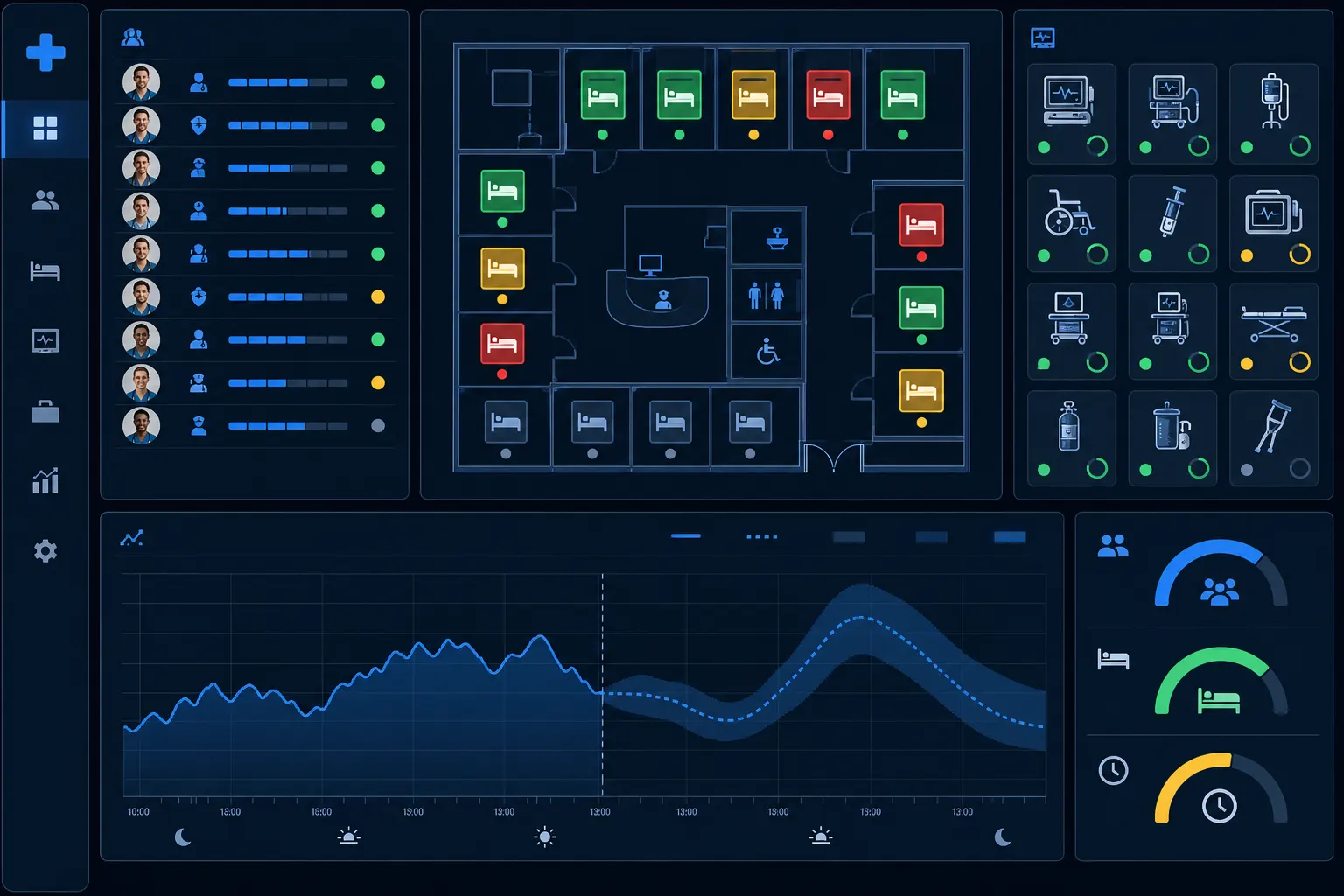
Emergency department operational performance is ultimately constrained by the availability and allocation of three categories of resource: clinical staff, physical space (beds and treatment bays), and medical equipment. Suboptimal resource allocation—nurses deployed to low-acuity areas while high-acuity bays are understaffed, beds occupied by boarding admitted patients while new arrivals wait in triage, critical equipment unavailable at the point of need—generates preventable delays, clinician burnout, and patient safety incidents. Artificial intelligence applied to resource orchestration moves emergency departments from reactive resource management—responding to deficiencies as they emerge—to proactive management informed by predictive models that anticipate demand hours in advance.
Predictive Staff Deployment
Nurse-to-patient ratio management in the ED is complicated by the unpredictability of patient volume and acuity mix. Static shift staffing models, built on historical average volume by shift, consistently underperform during demand surges and represent inefficient over-staffing during quiet periods. Machine learning models that incorporate patient volume forecasts, acuity predictions, anticipated procedure rates, and real-time census data can generate dynamic staffing recommendations—specifying not merely how many nurses are needed but which skill mix and zone assignments are appropriate for the predicted patient composition. A predictive staffing deployment study in a tertiary Australian ED documented a 12% reduction in overtime expenditure and an 18% improvement in nurse-to-patient ratio adherence following deployment of an ML-guided staffing tool (Rauch et al., Emergency Medicine Australasia, 2021).
MEDPOI® (medpoi.com) approaches resource orchestration as an integrated capability: staff deployment recommendations are generated in the context of real-time bed availability, anticipated patient arrivals from the ambulance pre-notification feed, and pending discharge readiness across the inpatient wards—creating a system-level picture that enables the ED charge nurse and hospital operations team to make allocation decisions with full situational awareness rather than on the basis of isolated departmental data.
Real-Time Bed and Equipment Visibility
RFID and IoT-enabled asset tracking provides the real-time equipment location data that makes AI-driven resource orchestration operationally feasible. When the management platform knows that both portable ventilators are in use, that the only available crash cart is on the second floor, and that a septic patient in Resus Bay 3 will require ventilator support within the next 30 minutes based on their deterioration trajectory, it can trigger a proactive equipment reallocation request before the clinical urgency materialises—rather than generating a critical shortage alert at the moment of maximum clinical need. Bed turnover AI—predicting which occupied beds will become available within the next 90 minutes based on physician discharge order patterns, transport request latencies, and housekeeping queue data—enables receiving beds to be allocated to incoming patients before the current occupant has physically departed, compressing the bed-to-patient interval that is the primary determinant of ED boarding duration.