

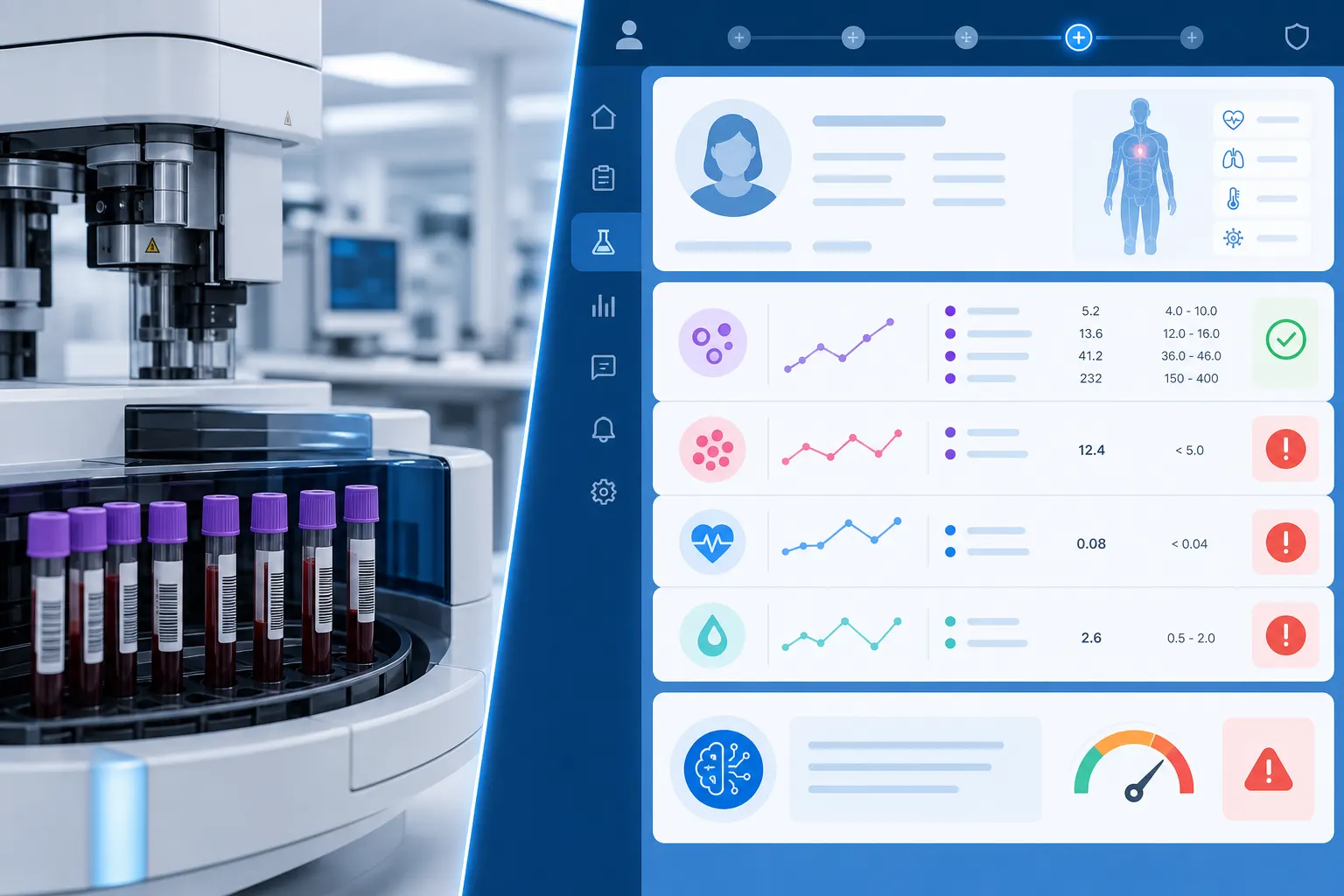
The laboratory information system (LIS) represents one of the richest sources of time-sensitive clinical data in the hospital, yet it remains among the most poorly integrated with real-time clinical decision support in the emergency department. In the conventional workflow, a clinician orders a laboratory test, the sample is collected, transported, processed, and a result report is generated in the LIS—available for review when the clinician next accesses the patient record. This passive retrieval model is fundamentally misaligned with the dynamic, time-critical environment of emergency triage, where deterioration can be silent and every result carries potential urgency. Artificial intelligence applied to LIS integration transforms this model from passive retrieval to active, context-aware clinical alerting.
Beyond Critical Value Notification
Most hospital LIS platforms provide critical value notification—an alert to the ordering clinician when a result crosses a predefined threshold (e.g., potassium >6.5 mmol/L, haemoglobin <70 g/L). This binary threshold approach, while a necessary safety backstop, fails to capture the full clinical significance of laboratory data in the context of the individual patient's presentation and history. A troponin of 0.08 ng/mL in a 65-year-old with chest pain and pre-existing renal impairment requires fundamentally different clinical action than the same value in a 25-year-old marathoner post-exertion. AI-powered LIS integration replaces threshold-based alerting with contextual interpretation: each result is evaluated in the context of the patient's current vital signs, triage acuity, presenting complaint, and historical laboratory baseline, generating a composite clinical significance score rather than a simple normal/abnormal flag.
Comprehensive hospital intelligence platforms—such as MEDPOI® (medpoi.com)—integrate directly with the LIS through HL7 ORU message streams, applying AI interpretation models at the point of result release before the data is presented to the clinician. The output is not a raw result value but an enriched clinical data point: the result, its trend against historical values from the patient’s medical folder, its contextual significance given the current clinical picture, and a suggested care pathway response. For emergency triage environments where rapid clinical decision-making is essential, this enrichment layer represents a qualitative transformation in the informational value of routine laboratory data.
Point-of-Care Testing and AI
Point-of-care testing (POCT) technologies—handheld blood gas analysers, bedside troponin assays, rapid sepsis biomarker platforms—have reduced laboratory turnaround times to minutes in the emergency setting, but their integration with clinical information systems and AI decision support has lagged behind their analytical capabilities. AI-enabled POCT integration, in which handheld device results feed directly into the AI triage platform and trigger pathway-specific response recommendations within seconds of result availability, represents the frontier of laboratory-triage integration. Early POCT AI integration studies in sepsis pathways have demonstrated additional door-to-antibiotic time reductions of 8–14 minutes compared with LIS-integrated POCT alone, suggesting that the AI interpretation layer adds clinically meaningful value beyond mere connectivity.