

The Decentralization of Clinical Assessment
The traditional model of healthcare delivery — centralized within hospital walls and predicated on physical proximity to clinicians — is undergoing a fundamental transformation. Advances in miniaturized sensor technology, edge computing, and artificial intelligence have collectively enabled a new paradigm: the deployment of hospital-grade diagnostic capabilities at distributed points of care. This shift is particularly consequential in addressing longstanding inequities in healthcare access, reducing the burden on emergency facilities, and enabling earlier detection of clinically significant pathology.
Medical Points of Intelligence: Architecture and Philosophy
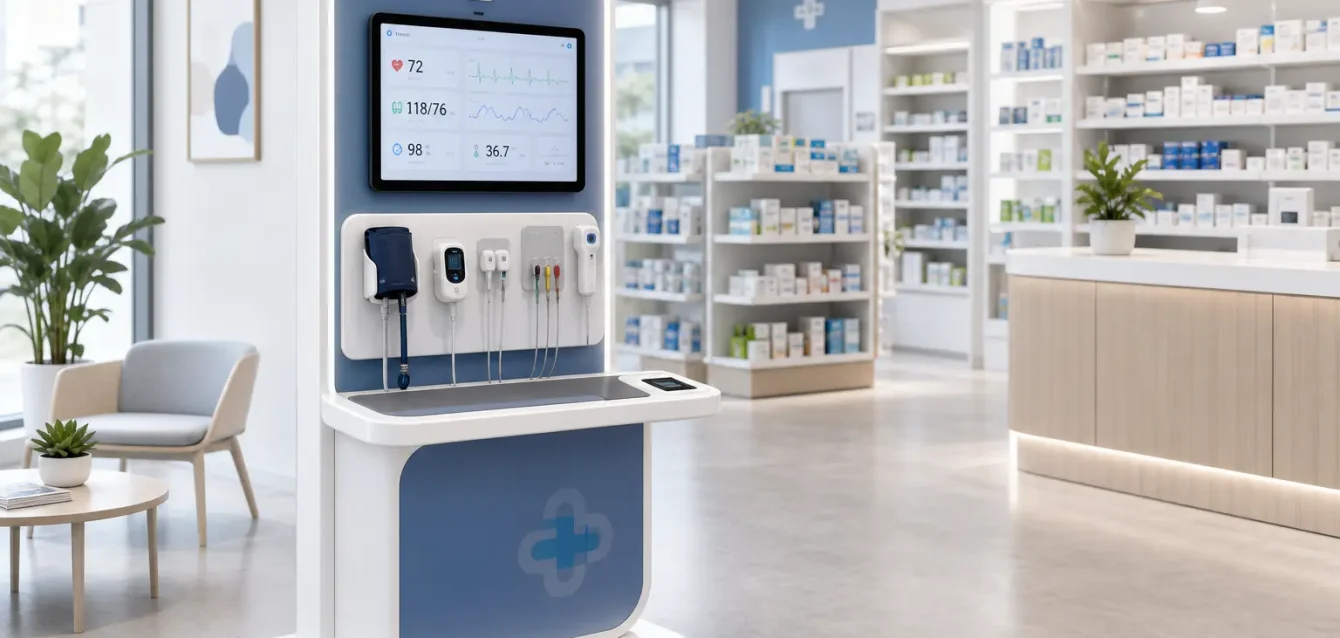
A Medical Point of Intelligence (POI) represents a convergent platform in which certified medical hardware and intelligent software are integrated within a single, deployable unit. Unlike conventional telehealth systems that rely solely on camera-based video consultations, a POI station enables the acquisition of objective, quantitative clinical data through an array of integrated medical devices. Blood pressure, cardiac electrical activity, peripheral oxygen saturation, body temperature, blood glucose, and imaging-derived data can each be acquired, digitized, and transmitted to authorized clinicians in real time.
This design philosophy reflects a recognition that meaningful clinical assessment requires physiological evidence, not merely visual observation. The DH-800 station, developed within the broader CAREPOI® ecosystem, embodies this principle by integrating eleven distinct medical modalities into a single ergonomic platform intended for deployment in pharmacies, primary care centers, municipal health points, airports, corporate wellness facilities, and remote community access points.
Artificial Intelligence as the Intelligence Layer
The utility of a multi-device clinical platform depends critically on the software layer that processes and contextualizes the acquired data. Raw vital sign measurements, while necessary, are insufficient for clinical decision support without the interpretive frameworks that experienced clinicians apply when synthesizing multiple data streams. Artificial intelligence, trained on large-scale clinical datasets, can replicate and extend these interpretive capabilities, identifying patterns and risk stratifications that exceed the capacity of individual measurement thresholds.
Within a POI architecture, AI algorithms operate across several functional domains: signal quality validation, artifact rejection, normalization against patient demographics, risk classification, and clinical recommendation generation. These functions operate continuously during a patient encounter, providing clinicians with actionable summaries rather than raw data streams. Importantly, the AI layer maintains the clinician as the final decision-making authority while substantially reducing the cognitive load associated with multi-parameter monitoring.
Data Integration and the Connected Health Record
The clinical value of a POI is not limited to the moment of measurement. Through automated synchronization with electronic health record systems, all acquired data becomes part of the patient’s longitudinal medical record, accessible to authorized healthcare professionals across the care continuum. This interoperability enables trend analysis, supports chronic disease management, and provides emergency departments with pre-hospital clinical context when patients present acutely.
Intelligence platforms designed for healthcare networks — such as those supporting distributed POI deployments — enable population-level analytics alongside individual patient monitoring. This dual-scale capability supports both clinical care and public health surveillance, creating a healthcare infrastructure that is simultaneously responsive to individual needs and capable of detecting epidemiological signals at scale.
Deployment Contexts and Clinical Implications
The modular architecture of current-generation medical POI systems permits adaptation to diverse deployment environments. In pharmacy settings, POI stations extend the clinical role of pharmacists, enabling medication management consultations to be accompanied by objective physiological assessment. In municipal health access points, they democratize specialist-level evaluation for underserved populations. In occupational health contexts, they enable periodic workforce health monitoring with clinical-grade accuracy.
Emergency departments that receive patients from POI networks benefit from structured, pre-acquired clinical data that can inform triage decisions and reduce assessment time. This pre-hospital intelligence represents a significant operational advantage in environments where time-to-diagnosis is directly correlated with patient outcomes. As healthcare systems globally seek to manage increasing demand while maintaining quality, AI-enabled medical kiosks offer a scalable, evidence-based mechanism for extending clinical reach without proportional increases in clinical staffing.
Conclusion
The emergence of AI medical kiosk platforms marks a pivotal evolution in the architecture of healthcare delivery. By combining certified medical hardware with sophisticated AI-driven analytics, these systems transform any suitable location into a capable point of clinical assessment. The implications for access, equity, efficiency, and quality of care are substantial. As the technology matures and deployment scales, the medical kiosk will increasingly serve as a fundamental infrastructure component of intelligent, distributed healthcare systems.