

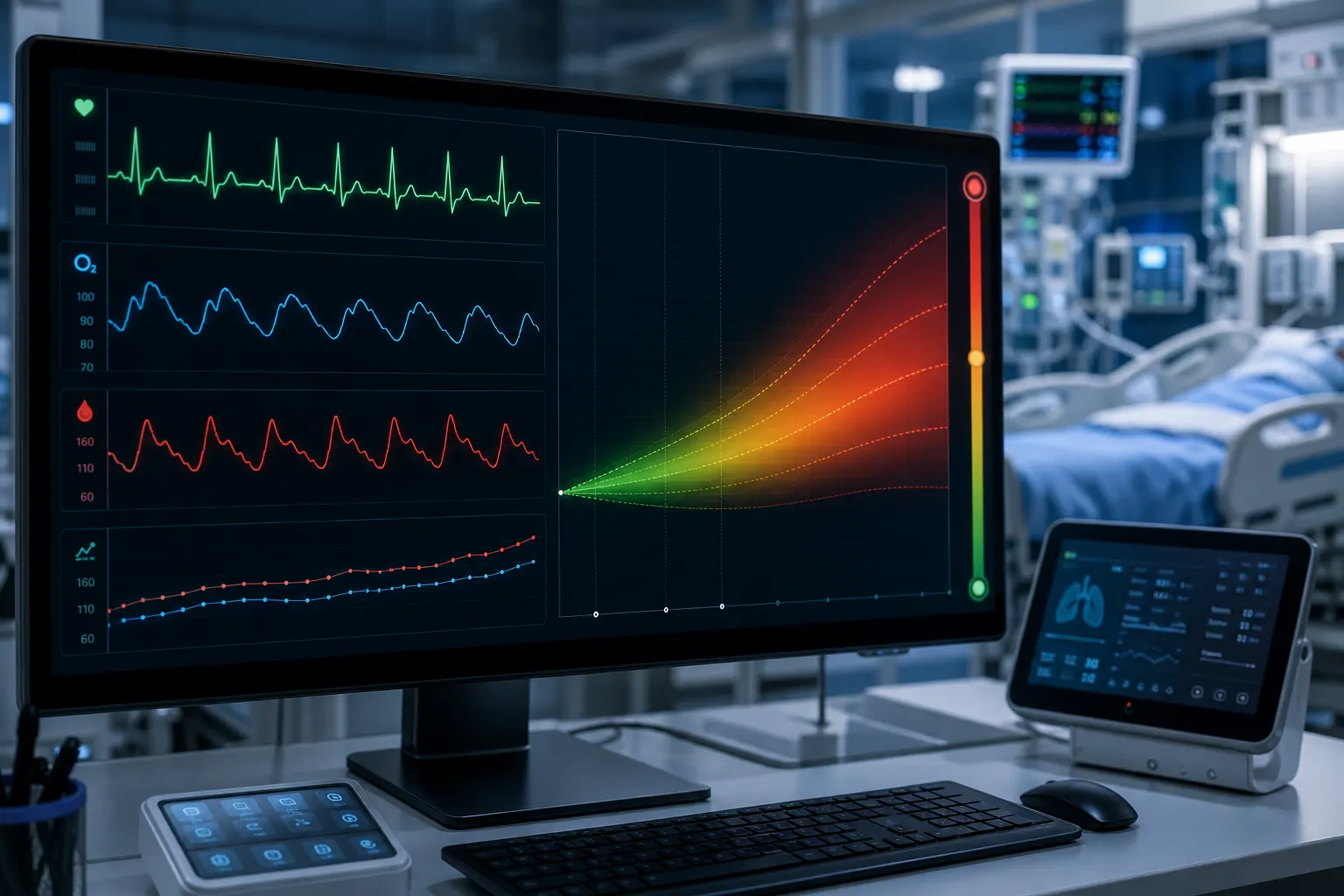
In-hospital cardiac arrest and unanticipated ICU transfer are largely preventable events, preceded in the majority of cases by a six-to-eight-hour window of measurable physiological deterioration. Early warning scores (EWS) such as NEWS2 and MEWS were designed to capture this deterioration trajectory through periodic vital sign assessment, but their reliance on intermittent observation and their use of linear scoring thresholds limits both sensitivity and timeliness. Artificial intelligence—operating on continuous monitoring streams and integrating multiple physiological parameters simultaneously—represents a paradigm shift in deterioration detection capability.
Limitations of Conventional EWS
NEWS2 calculates a composite score from six parameters (respiratory rate, oxygen saturation, systolic blood pressure, pulse rate, level of consciousness, temperature) at the point of measurement. Its principal limitation is temporal: measurements are typically taken every four to twelve hours in ward settings, creating observation gaps during which deterioration may progress without detection. Furthermore, NEWS2 does not incorporate trends—a steadily rising respiratory rate from 16 to 21 over four hours is clinically significant, but neither individual value triggers an alert. Machine learning models trained on high-frequency monitoring data capture precisely this trend information, identifying deterioration trajectories rather than threshold crossings.
Evidence for AI-Augmented EWS
A landmark prospective study at Columbia University Irving Medical Center (Ye et al., NPJ Digital Medicine, 2022) compared a deep learning EWS against NEWS2 in 7,482 hospitalised patients, demonstrating that the AI model identified 83% of deterioration events at least two hours before they occurred, compared with 57% for NEWS2, at the same specificity threshold. The TREWS sepsis alert system (Henry et al., Nature Medicine, 2022), deployed prospectively across five hospitals, reduced 30-day sepsis mortality by 18.2% compared with a control period—a magnitude of effect rarely seen in single-intervention critical care trials. These results establish AI-augmented EWS as one of the highest-evidence AI applications in acute hospital medicine. Emergency platforms specifically designed for continuous patient monitoring—including triage-integrated systems like ERTRIAGE® (ertriage.com)—extend this capability to the triage and early ED observation phase, where deterioration can occur before formal admission.
Alert Design and Clinical Uptake
The clinical effectiveness of any AI-based EWS is ultimately determined by clinician response behaviour rather than algorithmic performance alone. Alert fatigue—the progressive desensitisation of clinical teams to high-frequency, low-positive-predictive-value notifications—is the principal implementation risk. Strategies that have demonstrably improved alert uptake include contextual explanation panels (showing the specific vital sign trends that triggered the alert), recommended actions specific to the predicted deterioration pattern, and alert suppression logic that silences notifications for patients in whom deterioration is expected and clinically managed. Human factors design, as much as machine learning methodology, determines the real-world impact of AI EWS deployment.