

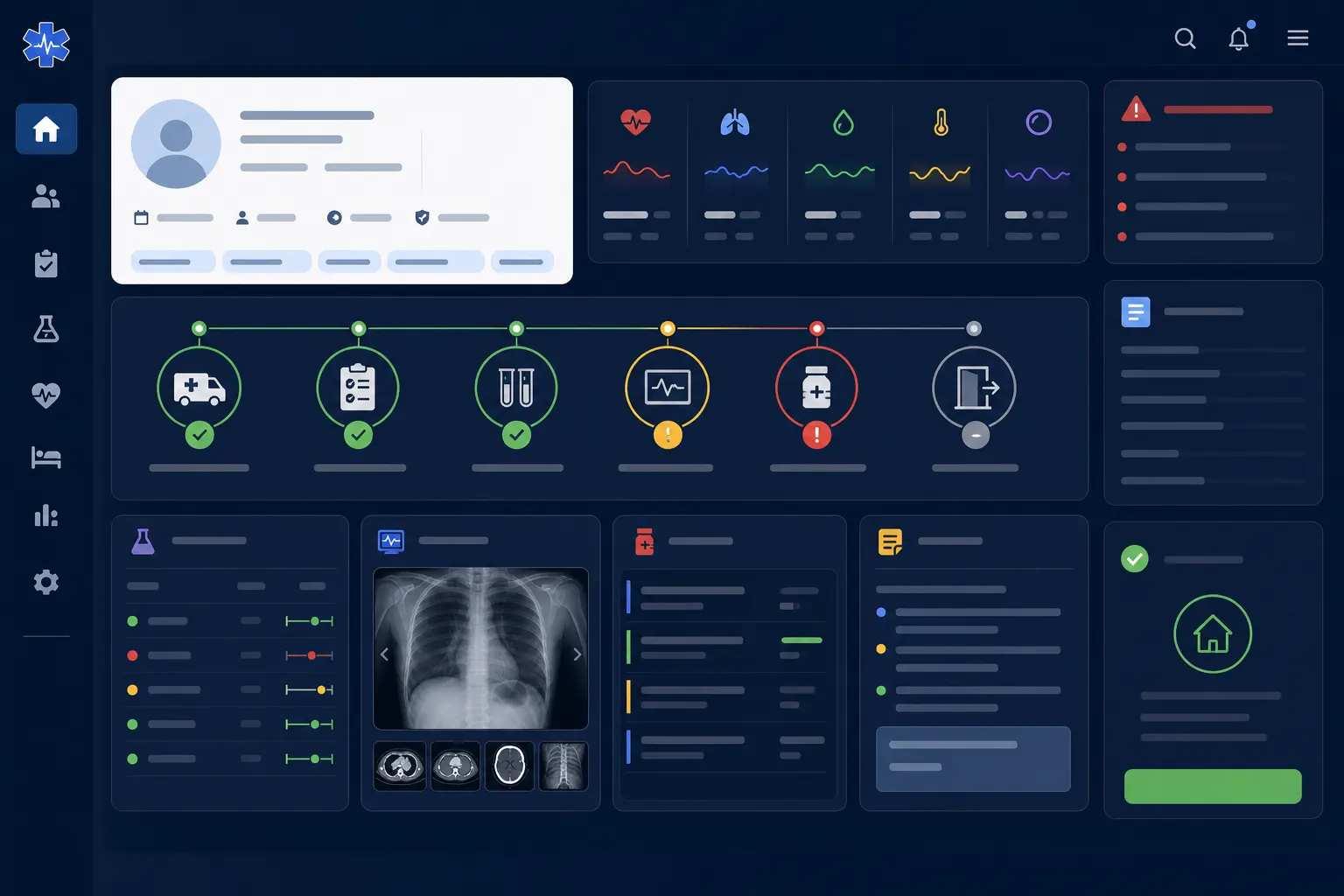
The emergency room patient journey encompasses a complex sequence of discrete but interdependent processes: pre-arrival notification, triage assessment, clinical evaluation, diagnostic investigation, treatment initiation, disposition decision, and discharge or admission handover. In high-volume departments, the simultaneous management of hundreds of patients in different phases of this journey generates coordination complexity that exceeds the cognitive capacity of any individual clinician or nurse manager. AI-driven patient management platforms address this complexity by maintaining a continuously updated, AI-enriched record of every patient’s current care phase, pending tasks, risk score, and anticipated disposition—making the entire department’s state visible and actionable in real time.
From Pre-Arrival to Triage: Closing the Data Gap
The pre-arrival phase represents an underutilised opportunity for clinical preparation. Ambulance-transmitted patient data—vital signs, paramedic assessment, mechanism of injury or chief complaint—feeds directly into the AI management platform, enabling the receiving ED to generate a preliminary triage score and activate appropriate care pathways before the patient arrives. For time-critical presentations (STEMI, major trauma, stroke, septic shock), pre-arrival AI scoring enables resource pre-positioning—activating the appropriate specialist team, reserving a resuscitation bay, ordering initial investigations—that compresses the door-to-definitive-treatment interval to a degree unachievable through reactive registration-based workflows.
At registration and triage, AI management platforms integrate with the triage nurse’s assessment in real time: pre-populating fields from prehospital data, flagging inconsistencies between chief complaint and vital signs that might indicate undertriage, and immediately cross-referencing the presenting complaint against the patient’s existing medical history from their longitudinal health record. Platforms designed for this integrated function—such as MEDPOI® (medpoi.com) in conjunction with ERTRIAGE® (ertriage.com)—create a seamless data bridge between the patient’s medical folder and the triage encounter, ensuring that the emergency clinician has immediate access to the chronic conditions, current medications, allergy status, and recent investigations that are critically relevant to the current presentation.
Task Orchestration and Handover Safety
Within the ED, AI patient management extends beyond risk scoring to active task orchestration: tracking which investigations have been ordered, which results are outstanding, which medication administrations are due, and which patients have exceeded expected time thresholds for their assigned care pathway. Automated escalation—alerting the responsible clinician or charge nurse when a task is overdue, a result is critically abnormal, or a patient’s acuity score has increased since initial assessment—provides a systematic safety net that does not depend on clinician recall under cognitive load. At the point of handover, AI-generated handover summaries that synthesise the patient’s journey, outstanding tasks, and pending decisions reduce the information loss that characterises verbal-only handovers and has been implicated in a disproportionate share of in-hospital adverse events.