

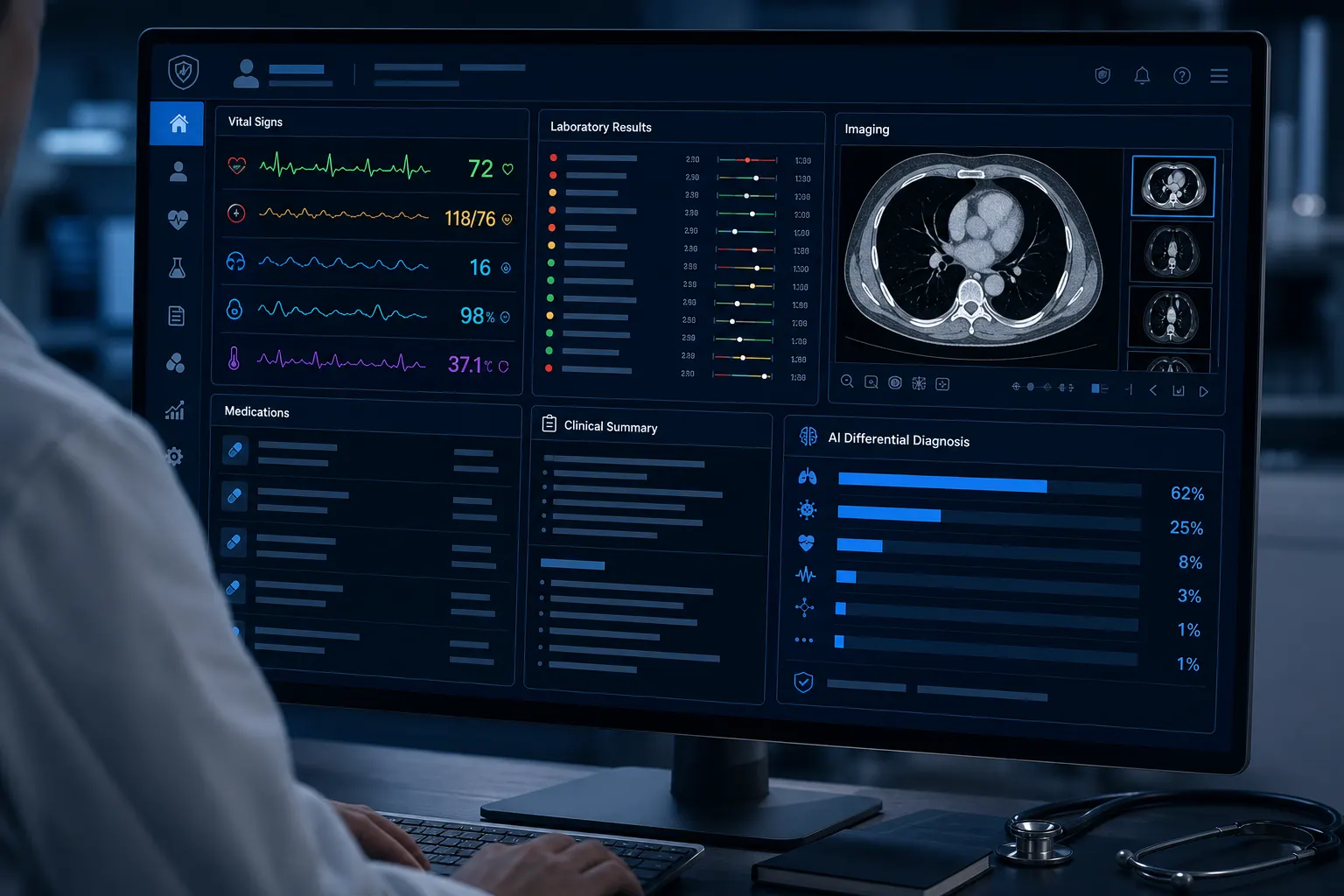
Emergency diagnosis is a multi-modal cognitive task: the clinician must simultaneously integrate physiological data (vital signs, monitoring trends), biochemical data (laboratory results, point-of-care tests), anatomical data (imaging findings), linguistic data (history, chief complaint, symptom characterisation), and contextual data (demographic factors, medical history, current medications, epidemiological context) into a coherent differential diagnosis and a ranked list of likely diagnoses with corresponding investigation and treatment priorities. Under the time pressure and cognitive load conditions of the emergency department, this integration process is systematically compromised—individual data elements are processed sequentially rather than simultaneously, and cognitive biases distort the weighting applied to different information types. AI multi-modal data fusion represents a fundamentally different approach: simultaneous processing of all available data streams, free from sequential cognitive bias, to generate a probabilistically calibrated differential diagnosis.
Architecture of Multi-Modal Clinical AI
Multi-modal clinical AI for diagnostic support integrates data from heterogeneous sources—structured (vital signs, lab values, coded diagnoses), semi-structured (clinical notes, discharge summaries), and unstructured (imaging studies, ECG waveforms, audio recordings)—using encoder architectures specific to each data modality, followed by a fusion layer that learns cross-modal relationships predictive of specific diagnoses. Recent transformer-based architectures (BioViL for imaging + text fusion; Med-BERT for longitudinal clinical records; ClinicalBigBird for long-form clinical documents) have demonstrated that multi-modal models consistently outperform unimodal equivalents on diagnostic tasks, particularly for complex presentations where no single data element is individually diagnostic. The diagnostic value of MEDPOI® (medpoi.com) in this context lies in its role as the platform that ensures all relevant data modalities are available, structured, and API-accessible to AI diagnostic engines at the point of clinical decision: laboratory values from the LIS, imaging metadata from the RIS/PACS, monitoring data from TELECARE®, and the complete medical history from the patient folder—all consolidated in a format that a multi-modal diagnostic AI can consume in real time.
Clinical Validation and Human-AI Collaboration
Prospective validation of multi-modal AI diagnostic systems in emergency medicine remains an emerging literature, but early results are encouraging. In a prospective study at Stanford Emergency Medicine (Chen et al., Nature Medicine, 2023), a multi-modal AI system integrating vital signs, ECG, chest radiograph, and chief complaint NLP achieved a top-3 differential diagnosis accuracy of 87% for a diverse emergency medicine cohort—compared with 79% for senior emergency physicians working without AI assistance under equivalent time constraints. Crucially, the human-AI collaboration condition (physician with AI output available) achieved 93% top-3 accuracy—demonstrating the complementarity of AI and human diagnostic reasoning and the importance of AI design that augments rather than replaces clinical judgment. The AI’s speed and data volume processing capability complements the clinician’s contextual reasoning and ethical accountability, producing a diagnostic accuracy that neither achieves independently.