

The Burden of Skin Disease and the Access Gap
Skin conditions collectively represent the fourth most common cause of non-fatal disease burden globally, with melanoma and non-melanoma skin cancers accounting for a substantial proportion of cancer diagnoses and dermatological emergencies. Despite this epidemiological significance, access to dermatological expertise is severely constrained in many healthcare systems, with waiting times for specialist evaluation often measured in months — intervals during which rapidly evolving malignancies may progress to more advanced and less treatable stages. Community-level screening programs, while conceptually attractive, have historically been limited by the requirement for trained dermatologists or specialist nurses to perform and interpret dermoscopic examination.
Convolutional Neural Networks in Dermoscopic Analysis
The application of deep learning to dermoscopic image analysis has produced one of the most extensively validated AI diagnostic systems in medicine. Studies published in leading clinical journals have demonstrated that convolutional neural networks trained on curated dermoscopic image datasets can classify pigmented skin lesions with accuracy that matches or exceeds the performance of experienced dermatologists across the spectrum of common and clinically significant conditions, including melanoma, basal cell carcinoma, seborrheic keratosis, and dermatofibroma.
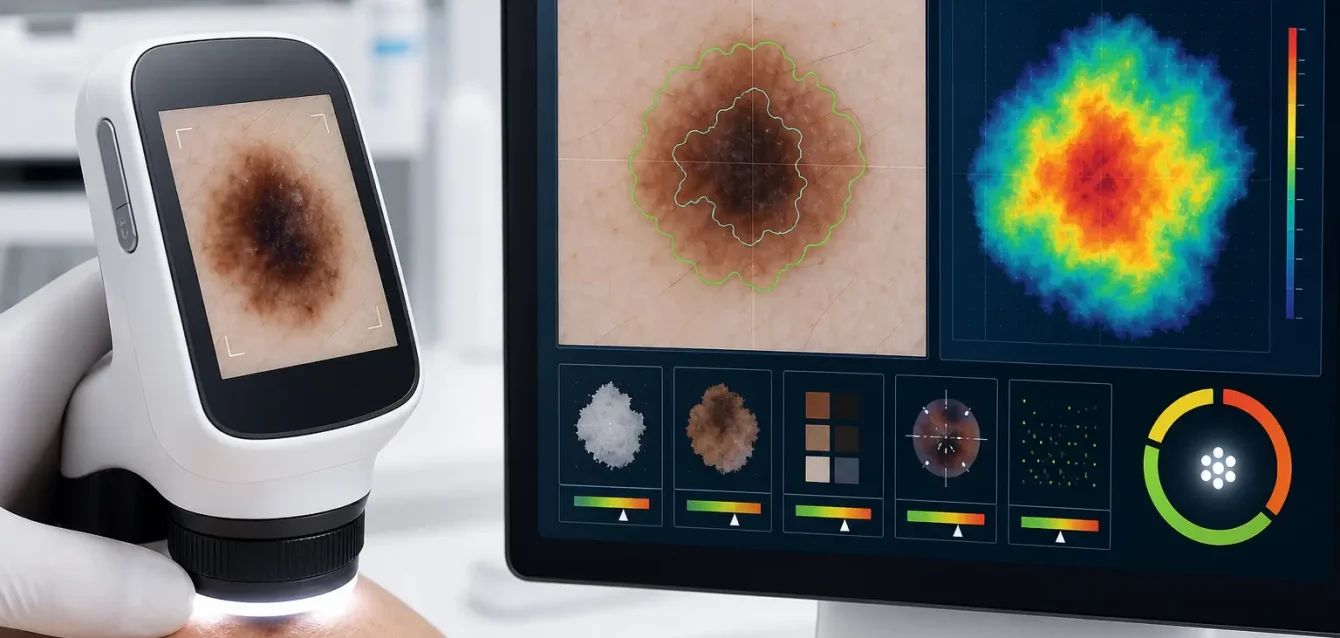
These algorithms evaluate structured dermoscopic features — including asymmetry, border irregularity, color heterogeneity, and dermoscopic pattern elements — alongside unstructured pixel-level features extracted through deep network layers, generating probability estimates for malignancy risk that are substantially more reproducible than human visual assessment under time pressure. The integration of clinical metadata, including patient age, anatomical site, and lesion evolution history, further refines classification accuracy.
Dermatoscopy Within Medical POI Platforms
Medical Points of Intelligence incorporating high-resolution digital dermatoscopes with integrated polarized illumination enable standardized dermoscopic image acquisition in community settings. The AI interpretation system analyzes acquired images in real time, applying malignancy risk stratification scores and generating structured reports that flag lesions requiring expedited specialist review. The system also provides educational output to the patient, explaining the assessment findings and recommended next steps in accessible language.
Critically, the platform maintains all acquired dermoscopic images and associated AI reports within the patient’s medical record, creating a longitudinal dermoscopic monitoring capability that is particularly valuable for patients with dysplastic nevus syndrome or personal or family histories of melanoma. Automated comparison with previous images enables early detection of lesion evolution that falls below the threshold of immediate clinical concern but warrants monitoring — exactly the capability that most community dermatological screening programs cannot provide.
Conclusion
AI-enabled dermatoscopy within medical POI platforms addresses a critical gap in community-level dermatological surveillance. By providing validated skin lesion analysis at distributed care points, these systems enable earlier detection of malignant pathology, reduce unnecessary specialist referrals for benign lesions, and create a longitudinal monitoring capability that individual patient encounters cannot replicate. The integration of dermatoscopic AI within comprehensive medical POI deployments represents a meaningful advance in accessible, preventive dermatological care.