

Hypertension: A Silent Epidemic Demanding Intelligent Surveillance
Hypertension represents one of the most prevalent and consequential modifiable risk factors for cardiovascular disease globally, affecting approximately 1.28 billion adults according to World Health Organization estimates. Despite its clinical significance, hypertension is frequently undetected, inadequately monitored, and suboptimally managed — partly because meaningful blood pressure assessment requires longitudinal measurement under standardized conditions, a requirement that is difficult to fulfill within the episodic structure of conventional primary care encounters.
Limitations of Isolated Measurement Paradigms
The clinical interpretation of a single blood pressure reading is confounded by numerous factors: measurement technique, patient anxiety (the white-coat effect), diurnal variation, recent physical activity, and device calibration. Guidelines from major cardiovascular societies increasingly recommend multiple readings obtained across varied contexts, including home monitoring and ambulatory monitoring, to establish a clinically reliable blood pressure profile. Artificial intelligence offers a mechanism for synthesizing these multi-source measurements into coherent, clinically actionable assessments.
AI-Enhanced Blood Pressure Analysis at Medical POI Stations
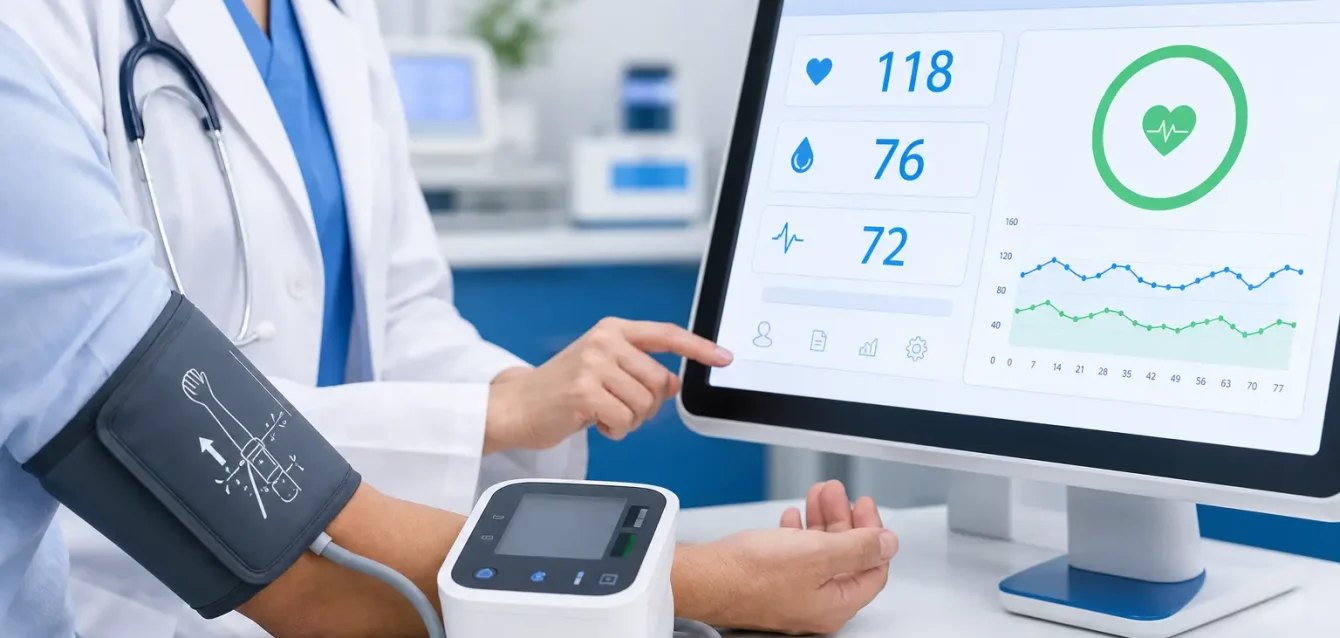
Medical Points of Intelligence equipped with certified automated blood pressure measurement devices provide a standardized acquisition context that reduces measurement variability while ensuring clinical-grade accuracy. When integrated with an AI analytics layer, each measurement is assessed not in isolation but within the context of the patient’s historical blood pressure profile, demographic parameters, and concurrent vital sign data. The AI system can identify patterns consistent with masked hypertension, morning surge hypertension, or orthostatic hypotension that would be invisible to single-reading assessment protocols.
Pulse wave analysis, increasingly available through advanced oscillometric algorithms, extends blood pressure assessment to include arterial stiffness indices and pulse pressure parameters. These measures are independently associated with cardiovascular risk and can be incorporated into AI risk stratification models that estimate 10-year cardiovascular event probability with accuracy comparable to traditional clinical risk calculators, while requiring no laboratory inputs.
Integration with the Patient Medical Record
Each blood pressure measurement acquired at a medical POI is automatically transmitted to the patient’s medical record within the clinical intelligence platform. Authorized clinicians receive not only the most recent reading but a structured summary of longitudinal trends, deviation alerts, and AI-generated risk flags. This continuous surveillance model transforms blood pressure monitoring from a periodic clinical event into an ongoing physiological assessment process, enabling earlier intervention when trends indicate deteriorating control.
The public health implications of large-scale POI-based blood pressure surveillance are significant. Population-level data collected through distributed medical POI networks can identify geographic hypertension burden patterns, inform resource allocation decisions, and support community health initiatives targeting modifiable cardiovascular risk factors. The combination of individual clinical utility and population health intelligence represents a compelling case for the integration of AI-enhanced blood pressure monitoring within comprehensive medical POI deployments.
Conclusion
Artificial intelligence applied to blood pressure monitoring at distributed points of care offers the potential to meaningfully address the clinical and epidemiological burden of hypertension. By moving beyond isolated measurements toward longitudinal, context-aware analysis, AI-enhanced POI stations provide both individual patients and healthcare systems with the intelligence necessary to detect, monitor, and manage cardiovascular risk at scale. This capability represents a critical component of any comprehensive strategy for preventive cardiovascular medicine in the twenty-first century.