- 0 Comments
- Telemedicine Stations
Telenursing:
The Next
Revolution
How Greece is redefining primary healthcare through remote nursing — and why the TELECARE platform, powered by CarePOI telemetry and physician collaboration, is the infrastructure that makes it real for millions.
Telenursing is not a technology project. It is a fundamental restructuring of who delivers healthcare, where it happens, and how millions of people who were previously invisible to the system finally receive continuous, dignified care.
The Case for Telenursing in Greece
Greece presents one of the most compelling — and pressing — cases for telenursing in all of Europe. With over 6,000 inhabited islands, vast mountainous terrain across Macedonia, Epirus, and the Peloponnese, and a primary healthcare network that has faced severe strain following years of economic austerity, the country has millions of citizens living in communities where consistent, proximate medical attention is simply not available. Rural general practices are understaffed. Specialist waiting times in urban centers stretch for months. Elderly populations — who represent one of the highest proportions in the EU — are left managing chronic conditions largely alone.
Yet Greece has something remarkable: a large, highly trained, and deeply motivated nursing workforce. Over 130,000 registered nurses practice in Greece, many in settings where their scope of practice is constrained by rigid institutional frameworks, physical distance from physicians, and limited diagnostic tooling. Telenursing changes all of this. It creates a distributed clinical intelligence network — nurses operating as the front-line health presence in communities, continuously connected to physicians, armed with real-time clinical data, and empowered to act meaningfully within defined scope-of-practice protocols.
The nurse is not a proxy for the doctor. She is the doctor’s eyes, hands, and continuous presence in places the doctor cannot reach. Telenursing makes this partnership systematic, safe, and scalable.
Primary Healthcare Design Principle · TELECARE PlatformThe COVID-19 pandemic exposed both the fragility and the latent potential of this model. Primary care visits collapsed as patients avoided hospitals. Chronic conditions deteriorated unmonitored. But in communities where telemedicine pilots were active — particularly those supported by mobile nursing visits paired with remote physician consultation — outcomes were measurably better. Continuity of care was maintained. Hospitalizations were prevented. The pandemic was, unwillingly, a proof-of-concept at scale for what telenursing can deliver.
What Telenursing Actually Is
Telenursing is the application of nursing practice and care delivery through telecommunications and digital health technologies — enabling registered nurses to assess, monitor, educate, support, and coordinate care for patients remotely or in distributed settings, always within a defined clinical governance framework that includes physician oversight and collaboration.
It is critically distinguished from simple telephone advice or chatbot symptom checking. A telenursing encounter, properly executed through the TELECARE platform, involves real clinical-grade biometric measurement taken at the patient’s location by the nurse using CarePOI telemetry nodes, transmitted in real time to a physician who reviews the data, collaborates with the nurse on assessment, and co-determines the care plan. The nurse is not acting alone — she is the intelligent, skilled interface between the patient and the full clinical team.
What a Telenursing Session Looks Like in Practice
-
1Scheduled Home or Community VisitThe registered nurse arrives at the patient’s home, elder care facility, community center, or remote clinic. She carries a CarePOI DH-600 or DH-800 Telemetry Node — a portable, clinical-grade multi-parameter measurement device. The session is scheduled through TELECARE and the patient’s physician is automatically notified and available.
-
2Clinical Measurement at Point of CareThe nurse conducts a structured clinical assessment using the CarePOI node: 12-lead ECG, blood pressure, SpO₂, temperature, blood glucose, weight, spirometry where indicated. All measurements are medical-grade — identical in accuracy to a hospital examination. Data transmits automatically to the TELECARE platform and the physician’s dashboard in real time.
-
3Nurse Assessment & DocumentationThe nurse conducts a structured nursing assessment — vital signs trend review, medication adherence check, wound assessment if relevant, functional status, cognitive screen, pain assessment, social determinants of health. All findings are documented in the TELECARE patient record using standardized nursing taxonomy (NANDA, NIC, NOC).
-
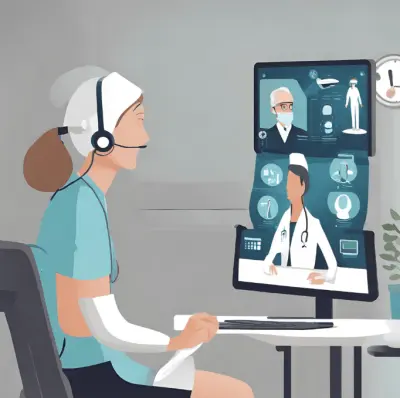
4Physician Collaboration via TELECAREThe nurse initiates a collaborative teleconsultation with the supervising physician through the TELECARE platform. The physician views all telemetry data, nursing notes, and patient history simultaneously. Together they discuss findings, the physician examines the patient via video, and a joint care plan is determined — prescription adjustments, referrals, escalation decisions, or continuation of current management.
-
5Care Plan Delivery & Patient EducationThe nurse implements the agreed care plan directly with the patient: medication instruction, lifestyle counselling, wound care, prescribed exercises, dietary guidance. Patient education is delivered at the bedside — not through a phone call or leaflet, but through direct, skilled interaction. The session is logged and the next contact scheduled.
-
6Continuous Remote Monitoring Between VisitsBetween nurse visits, patients with chronic conditions may use simplified home telemetry devices linked to TELECARE. Automated alerts notify the nurse and physician of out-of-range readings. The care team can initiate an unscheduled consultation without the patient needing to travel. Deterioration is caught early, hospitalizations prevented.
The TELECARE Platform: Infrastructure for Scale
TELECARE is the digital backbone of telenursing delivery at population scale. It is not a simple video call application or an electronic patient record — it is a purpose-built clinical coordination platform that integrates nurse workflow management, physician collaboration tools, CarePOI telemetry data ingestion, patient care management, regulatory documentation, and analytics into a unified operational environment.
The platform is designed around a core insight: telenursing works at scale only when the nurse’s cognitive load is minimized and her clinical capability is maximized. Every interface decision, every workflow step, every alert threshold and documentation template is engineered to let the nurse focus on the patient — not on the technology.
The Nurse–Physician Collaboration Model
The nurse–physician collaboration at the heart of TELECARE is not incidental — it is architecturally central. Greek healthcare law, like most EU member states, defines the scope of nursing practice with specific limits on independent clinical decision-making. Telenursing does not circumvent these limits; it works within them by making physician oversight genuinely accessible in real time.
In the TELECARE model, each nurse has a named supervising physician (or physician panel for shared caseloads). The physician receives all telemetry data as it is collected. For scheduled visits, the physician reviews data before the nurse departs the patient, and is available for live consultation at any point. For urgent findings — an arrhythmia detected mid-visit, a blood pressure crisis, a rapid clinical deterioration — a physician is reachable within 90 seconds through the TELECARE urgent consultation channel, backed by the CarePOI 24/7 Emergency Centre.
| Care Scenario | Nurse Role | Physician Role | CarePOI Telemetry |
|---|---|---|---|
| Routine chronic disease monitoring | Assessment, measurement, education, medication review | Asynchronous data review, prescription renewal, plan adjustment | ● Active Full parameter set |
| Deteriorating chronic patient | Clinical assessment, escalation initiation, interim interventions | Live teleconsultation, examination via video, urgent plan change | ● Active ECG + vitals + trending |
| Post-hospital discharge | Wound care, medication reconciliation, follow-up assessment | Discharge summary review, next-step planning, specialist liaison | ● Active Daily remote readings |
| Palliative / end-of-life | Symptom management, family support, comfort care coordination | Symptom management guidance, prognosis discussion, prescribing | ● Adapted Comfort-focused parameters |
| Mental health support | Psychological assessment, psychoeducation, safety monitoring | Psychiatric review via teleconsultation, medication management | ● Adapted Physiological stress markers |
| Emergency response | First response, triage, stabilization, emergency data capture | Immediate live consultation, emergency direction, ambulance coordination | ● Urgent Full real-time stream |
CarePOI Telemetry:
The Clinical Engine
The TELECARE platform’s clinical credibility rests on the quality of the data that flows through it — and that data quality is determined entirely by the CarePOI Telemetry Nodes that nurses carry into homes, clinics, pharmacies, and community settings across Greece. The DH-600 and DH-800 nodes are not consumer wellness devices. They are medical-grade, CE-marked clinical instruments that produce the same diagnostic quality data as in-hospital equipment.
- 12-Lead Electrocardiography: Full diagnostic ECG transmissible to cardiologist for interpretation; arrhythmia detection with auto-flagging of clinically significant patterns
- Non-invasive Blood Pressure: Oscillometric measurement with mean arterial pressure, pulse pressure, and hypertensive crisis threshold alerts
- Pulse Oximetry & Perfusion Index: Medical-grade SpO₂ with perfusion quality indicator — critical for COPD, heart failure, and post-COVID monitoring
- Blood Glucose (Glucometry): Capillary blood glucose with HbA1c trending estimation for diabetic patient management
- Body Temperature: Tympanic and forehead infrared measurement with fever grading and sepsis screening integration
- Spirometry: FEV1, FVC, Peak Flow — essential for respiratory disease monitoring without clinic visit
- Body Weight & Composition: Wireless scale integration for heart failure fluid monitoring (critical daily measurement)
- Stethoscopy (DH-800): Digital auscultation transmitted to physician in real time — heart sounds, lung fields, bowel sounds
Primary Healthcare at Population Scale
The transformative potential of telenursing in Greece is not about any single patient or any single nurse. It is about what happens when the model is deployed at population scale — when thousands of nurses, each empowered with TELECARE and CarePOI tools, become the continuous clinical presence across communities that currently have none.
The Populations TELECARE Reaches First
For each of these populations, telenursing through TELECARE and CarePOI delivers something the existing system has never provided: continuity. Not an episodic interaction when a crisis forces someone to a hospital — but a ongoing, monitored, supported relationship between a known nurse, a named physician, and a patient who knows exactly what to do and who to call.
Professional Framework &
Clinical Governance
Telenursing in Greece operates within the regulatory framework established by the Hellenic Nursing Councils (ESNO, TEINs) and the national health legislation governing nursing scope of practice. The TELECARE platform is designed in full compliance with this framework — ensuring that every telenursing interaction is clinically governed, documented, and professionally defensible.
Critically, TELECARE does not position telenursing as a nurse-independent practice. The physician relationship is constitutive — it is built into the workflow, not bolted on. Nurses operate with expanded clinical capability precisely because physician oversight is genuinely available, not theoretically present. This distinction matters both legally and clinically: it is the nurse–physician dyad that makes telenursing safe, not the nurse alone.
One Platform.
Infinite Reach.
TELECARE integrates nurse workflow, physician collaboration, CarePOI telemetry data, patient care management, and population analytics into a single, coherent operational platform — designed to function flawlessly from an Aegean island to a mountain village in the Pindus range.
From EU Research Project
to National Healthcare Service
The Geography That Makes
Telenursing Essential
No country in Europe has a geographic profile that creates a stronger imperative for distributed, technology-enabled healthcare than Greece. Understanding this geography is understanding why telenursing is not an option here — it is a structural necessity.
Greece’s territory is defined by fragmentation. The mainland is deeply mountainous — the Pindus range divides Epirus from Macedonia and Thessaly; the Taygetos and Parnon ranges separate communities across the Peloponnese. Winter road access to hundreds of mountain villages is seasonally impossible. Helicopter medevac is the only emergency option for some communities. Against this backdrop, the idea of expecting every elderly diabetic or cardiac patient to travel regularly to a city clinic is not merely inconvenient — it is clinically dangerous. People do not make the journey. Conditions deteriorate unmonitored. Hospitalizations occur that were entirely preventable.
The island geography adds a different but equally urgent dimension. Greece has 227 inhabited islands and over 6,000 total islands. Of the inhabited islands, the majority are small — under 1,000 people — and many have no resident physician. The nearest hospital may be a ferry ride away in calm weather, inaccessible in winter storms. The nursing infrastructure exists on these islands. What has been missing is the technology, the physician linkage, and the clinical governance framework to convert that nursing presence into a complete primary care service. TELECARE provides exactly these elements.
The Future of Greek
Primary Care Is
Already Here
Twenty years of research, development, and real-world deployment have produced a platform, a clinical model, and a technology ecosystem that is ready to serve millions. The work of SYSTSERV through the Telenursing EU Project and the subsequent evolution of TELECARE and its CarePOI integration is not a promise of what telenursing could be. It is the evidence of what it already is — and an invitation to every health authority, healthcare organisation, insurer, and community in Greece to be part of the next chapter.